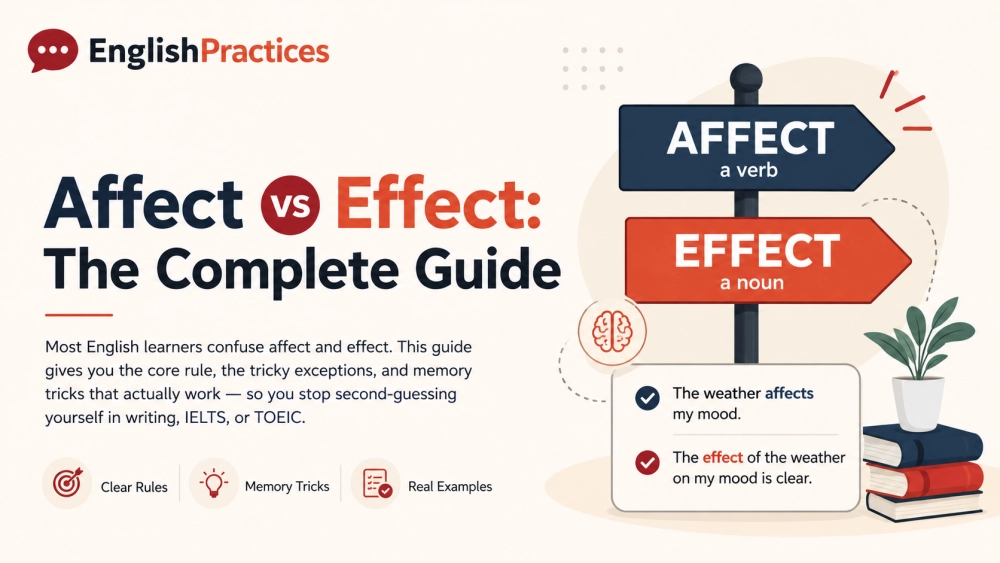
The simplest rule: "affect" is a verb and "effect" is a noun. That single distinction covers roughly 90% of every situation you will ever encounter in writing, conversation, or exams. But in that remaining 10% — the exceptions, the fixed phrases, the formal edge cases — learners at every level still get caught out. And in an IELTS Writing Task 2 or TOEIC Part 5 question, one wrong choice carries a real cost.
Every year, English learners from Bangkok to Seoul, from Mexico City to London write sentences like "the weather effected my mood" or "the side affects were mild." According to the Cambridge English Learner Corpus, vocabulary confusion involving near-identical word pairs ranks among the most documented errors at intermediate level globally — and affect/effect sits consistently near the top of that list.
This guide gives you the core rule, the tricky exceptions, the memory tricks that hold up under exam pressure, and real-world examples across professional and academic contexts. By the time you finish reading, you will choose the right word automatically, without stopping to guess.
The Core Difference Between Affect and Effect
Before going deeper, here is the complete rule in one clean reference table.
| Word | Part of Speech | Core Meaning | Example |
|---|---|---|---|
| Affect | Verb | To influence or change something | Stress affects your sleep quality. |
| Effect | Noun | A result or outcome | Stress has a negative effect on sleep. |
Both sentences carry the same idea. The word's grammatical role — verb or noun — is the only thing that changes. And that shift in function is the entire distinction.
The two-second test:
-
Can you substitute "influence" and keep the sentence correct? → Use affect.
-
Does "the" or "an" fit naturally before the word? → Use effect.
How to Use Affect Correctly (It Is a Verb)
Affect is an action word. It describes the process of one thing influencing another — always moving from a subject outward to an object. Think of it as a cause in motion.
Here is the grammatical pattern in real sentences:
-
Pollution affects air quality in cities across Europe and Southeast Asia.
-
Lack of sleep affects memory, concentration, and decision-making.
-
How did the economic downturn affect small businesses in Vietnam and Thailand?
Each sentence follows a Subject–Verb–Object structure: something performs the action of affecting, and something else receives it. That pattern is your signal that affect is the right word.
Confirmation check: Replace affect with "influence." If the sentence still works, affect is correct.
-
"Pollution influences air quality." ✓ → Pollution affects air quality. ✓
-
"Did the storm influence their plans?" ✓ → Did the storm affect their plans? ✓
Understanding how verbs function inside a sentence is a core grammar skill. If you want to build on this foundation, the Complete English Grammar Guide at EP covers verb structures, tenses, and grammatical patterns across all proficiency levels, from A2 through C1.
How to Use Effect Correctly (It Is a Noun)
Effect is a result. It answers the question: "What happened because of that?" Unlike affect, which performs an action, effect exists as a consequence — it sits in the sentence rather than doing anything.
Here is how it appears in real writing:
-
The effect of climate change on ocean temperatures is measurable and accelerating.
-
The medication produced no visible effect within the first 48 hours.
-
Researchers are studying the long-term effect of screen time on adolescent brain development.
Notice that effect almost always follows an article ("the," "a," "an") or a preposition ("on," "of," "in"). Both positions belong exclusively to nouns.
Confirmation check: Place "the" directly before the word. Does it sound natural?
-
"The effect is significant." ✓
-
"The affect is significant." ✗ (grammatically incorrect in standard usage)
Effect pairs naturally with prepositions in academic and professional writing — phrases like "the effect on health," "the effect of caffeine," and "in effect" are all standard. If you're working on how prepositions attach to nouns, EP's guide on prepositions of time, place, and movement builds exactly that skill alongside today's lesson.
The RAVEN Trick: A Memory System That Holds Up Under Pressure
Knowing the rule is step one. Applying it automatically under exam time pressure is step two — and the gap between those two steps is where most learners lose marks.
EP recommends the RAVEN mnemonic:
Remember Affect is a Verb Effect is a Noun
Five letters. Four words. One rule that locks in. Learners across South Korea, Japan, Thailand, Singapore, and the UK who practice RAVEN consistently report that the correct word becomes intuitive within two weeks of regular use.
Pair RAVEN with the article test as a double-check:
-
Try placing "the" or "an" before the word.
-
Sounds natural → it's a noun → use effect.
-
Sounds off → it's likely a verb → use affect.
"The effect on the environment was severe." ✓
"The affect on the environment was severe." ✗
Two tests. Two seconds. One correct answer.
Common Affect vs Effect Mistakes in IELTS and TOEIC
These errors appear in exam writing scripts and professional emails with striking consistency. Here is the pattern — and the fix.
| Incorrect Sentence | Correct Sentence | Why the Correction Works |
|---|---|---|
| The rain effected our plans. | The rain affected our plans. | A verb is needed after the subject — use affect. |
| Stress has a lot of affect. | Stress has a lot of effect. | "A lot of" signals a noun follows — use effect. |
| The side affects were minimal. | The side effects were minimal. | "Side effects" is a fixed noun phrase — always effect. |
| Her speech had a big affect on us. | Her speech had a big effect on us. | "Had a big ___" needs a noun — use effect. |
| How does pollution effect children? | How does pollution affect children? | After "does," a verb is required — use affect. |
In IELTS Writing, the Lexical Resource criterion is scored separately from grammatical range. According to the IELTS Band Descriptors published by the British Council and IDP, a Band 7 response demonstrates "sufficient range of vocabulary to allow some flexibility and precision" with "only occasional errors." Consistently confusing affect and effect is exactly the type of lexical error that limits a response to Band 6 or below.
In TOEIC Part 5, questions test whether you understand a word's grammatical function — not just its rough dictionary meaning. Knowing that affect is a verb and effect is a noun is the fastest path through those questions.
The Exceptions: When Effect Becomes a Verb and Affect Becomes a Noun
Most guides stop at the 90% rule. This section covers the exceptions — because they do appear in advanced English contexts, and knowing them signals genuine mastery.
Exception 1 — Effect as a Formal Verb
In formal written English — legal documents, board reports, high-level academic papers — effect can function as a verb meaning "to bring about" or "to cause something new to come into existence."
-
"The incoming CEO aimed to effect lasting cultural change across the organization."
-
"Parliament moved to effect sweeping reforms in public health policy."
This is meaningfully different from affect (to influence). "They effected a change" means they created or caused that change to come into being. "It affected the change" means it had an impact on a change already in progress. The distinction is precise — and intentional in formal registers.
This usage is rare in everyday speech. If you're unsure whether it applies, restructure the sentence:
-
Instead of: "We aim to effect reform."
-
Write: "We aim to bring about reform." (Equally formal, far clearer.)
Exception 2 — Affect as a Noun in Psychology
In clinical psychology and psychiatry, affect functions as a noun. It refers to the external, observable expression of a person's emotional state during clinical assessment.
-
"The patient displayed a flat affect throughout the diagnostic interview."
-
"Clinicians noted a blunted affect following the change in dosage."
This is specialist vocabulary, confined to healthcare, academic, and clinical writing contexts. Outside those fields, using affect as a noun will read as an error. For learners pursuing academic IELTS in health sciences or social work pathways, it's useful knowledge — for everyone else, file it away and move on.
Fixed Phrases Every Learner Should Memorize
Several common English expressions use affect or effect as fixed units. Memorizing these as complete phrases removes all ambiguity.
Fixed phrases using effect (noun):
-
Side effects — unintended consequences, especially of medication (never "side affects")
-
Take effect — to become active ("The new law will take effect in January.")
-
In effect — in practice, essentially ("In effect, the clause makes the agreement void.")
-
To good effect — successfully ("She used her research to good effect in the presentation.")
Fixed phrases using affect (verb):
-
Adversely affect — to damage or harm ("Air pollution adversely affects respiratory health.")
-
Directly affect — to influence immediately and significantly ("This merger will directly affect both teams.")
These collocations matter in IELTS. Examiners reward Lexical Resource scores when learners use accurate, context-appropriate word partnerships — and phrases like "to good effect" or "adversely affected" signal a C1-level vocabulary range.
Affect vs Effect Across Real-World Contexts
Here is a cross-industry snapshot showing how each word functions in professional and academic writing globally.
| Context | Affect (Verb) | Effect (Noun) |
|---|---|---|
| Business | Budget cuts affect staff retention. | The effect of budget cuts is higher turnover. |
| Environment | Climate change affects coral reefs globally. | The effect on coral reefs has been devastating. |
| Medicine | Chronic stress affects cardiovascular health. | The long-term effect of chronic stress is well-documented. |
| Education | Poor nutrition affects student concentration. | The effect of poor nutrition is reduced academic performance. |
| Law / Formal | New regulations will affect all import contracts. | The full effect of the regulations remains unclear. |
In every row, the word's position reveals its function. Affect follows the subject and drives the action. Effect follows "the," sits after a preposition, or stands as the subject of its own clause. Structure is the guide.
Four Practice Strategies That Build Automatic Accuracy
Knowing a rule in theory is not the same as using it correctly at speed. These four strategies move affect and effect from short-term memory into automatic usage.
-
Daily sentence writing. Write five sentences using affect as a verb and five using effect as a noun. Change the context daily — health, business, environment, education, technology.
-
Sentence transformation. Take a sentence using affect and rewrite it using effect (and vice versa): "Stress affects sleep quality." → "The effect of stress on sleep quality is significant." This exercise trains you to shift grammatical structure, not just swap vocabulary.
-
Authentic reading with active noticing. Read BBC News, The Guardian, or The Economist and highlight every instance of affect and effect. Identify the grammatical role of each one. Patterns become obvious within a week.
-
Build connected grammar skills simultaneously. Affect/effect mastery connects directly to sentence-level grammar patterns. Understanding how conjunctions in English link cause and effect clauses builds the sentences where these words naturally live — for example, "Because emissions increased, the effect on global temperatures became measurable." Likewise, modal verbs pair frequently with affect: "This policy could seriously affect production timelines." Practicing these patterns together builds fluency across multiple grammar points at once.
Affect vs Effect in IELTS and TOEIC: Exam-Specific Guidance
IELTS Writing Task 2
Academic essays for IELTS frequently demand cause-and-consequence reasoning — exactly where affect and effect appear most naturally. High-scoring responses at Band 7 and above use these words with precision and variety.
Strong IELTS sentence patterns:
-
"Climate change affects biodiversity in ways that compound over decades."
-
"The long-term effects of rapid urbanization on mental health are becoming clearer."
-
"Technology has had a transformative effect on access to education across Southeast Asia."
Tense accuracy matters as much as vocabulary accuracy in IELTS. EP's guides on present perfect tense and past simple vs past perfect will help you combine word-level and tense-level accuracy in the same sentence — both of which IELTS examiners assess as separate, independent scoring dimensions.
TOEIC Part 5 and Part 6
TOEIC Part 5 tests vocabulary in grammatical context. The question structure commonly works like this:
-
"The new regulation will ___ all suppliers in the region." → affect (verb needed after auxiliary "will")
-
"The ___ of the new regulation on suppliers is still being assessed." → effect (noun needed after "The")
Learners who know RAVEN and the article test can answer both questions in under five seconds. In a 100-question timed exam, that speed advantage compounds into a meaningful performance gain.
The EP Perspective: Precision at the Word Level Builds Real Confidence
At EnglishPractices.com, we have supported English learners from the United Kingdom, the United States, Thailand, Vietnam, South Korea, Japan, Mexico, China, Singapore, and dozens of other countries for over 19 years. The pattern we observe consistently: learners who master precise vocabulary — knowing exactly when affect is right and when effect is right — develop a confidence in their English that extends far beyond any specific exam.
This matters because precision at the word level is how professional English actually works. A business email sent to a client in London, a university essay submitted in Singapore, a board presentation delivered in Seoul — in each of these contexts, the right word signals command of the language, and the wrong one raises doubt about it.
Grammar accuracy is a foundation, not a ceiling. Every rule EP teaches — from this one to the broader patterns covered across the EP grammar library — is rooted in real usage, real contexts, and real exam application. If you're building on today's lesson, the guides on passive voice and countable vs uncountable nouns are natural next steps. Both require the same underlying skill you've been developing here: identifying a word's grammatical function in a sentence before choosing the right form.
Conclusion: You Will Not Confuse These Words Again
Here is the complete rule in four clear points:
-
Affect = Verb. It influences something. Apply RAVEN. Substitute "influence" to confirm.
-
Effect = Noun. It is a result. Apply the article test. Does "the" or "an" fit naturally before it?
-
Effect as a verb exists in formal English — it means "to bring about." Use it deliberately, and rarely.
-
Affect as a noun exists in clinical psychology. Outside that context, ignore this usage entirely.
Apply those four points consistently, and affect/effect becomes one of the easiest distinctions in English grammar. Take the quiz below to confirm your understanding. Then explore EnglishPractices.com for structured grammar practice that builds directly on what you have learned today.
Want guidance on your IELTS or TOEIC preparation? Reach out to the EP team through EnglishPractices.com. Our advisors will review your current level and help you build a focused, efficient study plan around your exact target score and timeline.