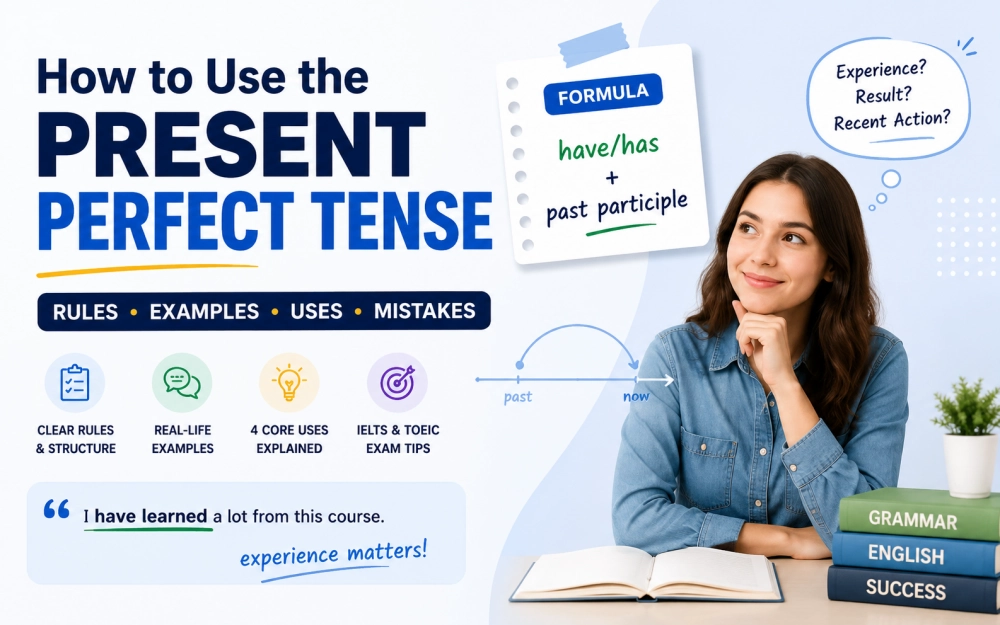
The present perfect tense appears in virtually every IELTS Writing Task 1 report, every TOEIC grammar section, and every professional email written in English — yet it consistently ranks among the top three grammar points where learners lose marks. The core answer: you form it with have/has + past participle (e.g., I have studied English for three years), and you use it whenever a past action or experience still connects to the present moment.
That definition sounds clean and simple. But learners from Bangkok to Bogotá, from Seoul to Ho Chi Minh City, get stuck at the same point: they know the formula but cannot feel when to use it. They write "I finished my homework" when they mean "I have finished my homework." They confuse "since" with "for" and lose Band scores. They use "I have visited Paris last year" and watch examiners mark it wrong.
In this guide, you will get:
- The exact formation rules, including irregular past participles that trip everyone up
- The four specific situations that always call for the present perfect
- A clear comparison table: present perfect vs. past simple
- The five most common mistakes — with precise corrections
- Targeted IELTS and TOEIC exam strategies
- A master signal words reference you can use immediately
Whether you are at A2 and learning tenses for the first time, or at B2 and preparing for a Band 7+ IELTS result, the clarity in this guide will change how you approach this tense.
What Is the Present Perfect Tense? (Definition, Formula, and Structure)
The present perfect tense links a past event to the present moment. That is its defining characteristic, and it is what separates it from the past simple. You are not just reporting that something happened — you are saying it happened and it matters now, either because the result is still present, the action is still ongoing, or the experience still defines the person.
The formula is fixed:
Subject + have / has + past participle
How to Form the Present Perfect in Positive, Negative, and Question Forms
| Form | Structure | Example |
|---|---|---|
| Positive | Subject + have/has + past participle | I have studied English for six months. |
| Negative | Subject + have/has + not + past participle | She has not replied yet. |
| Question | Have/Has + subject + past participle? | Have you ever visited Japan? |
Contractions are standard in spoken English and informal writing: "I have" → "I've," "She has not" → "She hasn't," "They have" → "They've."
Subject–Auxiliary Pairing:
| Subject | Auxiliary |
|---|---|
| I, You, We, They | have |
| He, She, It | has |
Getting this pairing wrong — writing "She have studied" instead of "She has studied" — is a basic but costly error on both IELTS and TOEIC. Make it automatic.
Regular vs. Irregular Past Participles — Why This Matters
Regular verbs simply add -ed to form the past participle: work → worked, visit → visited, finish → finished. Irregular verbs, however, follow their own patterns — and there are no shortcuts around learning them.
Some of the most frequently tested irregular past participles:
| Base Form | Past Simple | Past Participle |
|---|---|---|
| go | went | gone |
| write | wrote | written |
| eat | ate | eaten |
| see | saw | seen |
| take | took | taken |
| give | gave | given |
| know | knew | known |
| speak | spoke | spoken |
A strategic approach to memorizing these: group them by pattern. Write/wrote/written, drive/drove/driven, ride/rode/ridden all follow the same vowel shift. Learning one teaches you the family.
The 4 Core Situations That Require the Present Perfect Tense
Most grammar guides hand you a formula and a list of signal words. That only gets you so far. A genuine strategic approach means understanding the reasoning behind each use — the logic that makes the present perfect the right choice in that moment. Master the four situations below, and the tense starts to feel natural.
Use 1 — Life Experiences You Have (or Have Never) Had (Ever, Never, Before)
Use the present perfect to talk about whether an experience has occurred at any point in someone's life, without specifying when.
- Have you ever eaten Korean barbecue?
- I have never failed a TOEIC exam.
- She has visited seventeen countries.
- He has never studied abroad before.
The focus is the existence of the experience, not its timing. This is why "when" is irrelevant — and why adding a time phrase forces a switch to the past simple.
✅ I have seen that film. (At some point. I'm not saying when.) ❌ I have seen that film last week. (Wrong — "last week" is a specific time.) ✅ I saw that film last week. (Correct — past simple for a specific time.)
Use 2 — Recent Actions Whose Results Still Matter Right Now (Just, Already, Yet)
This use is particularly visible in TOEIC Part 5 and Part 6. The action may have happened moments or hours ago, but its result is felt in the present.
- I have just sent you the email. → The email is sitting in your inbox right now.
- She has already completed the training. → Earlier than expected; the completion is the current state.
- Have you submitted the application yet? → Asking whether an expected task is now done.
Pattern note: "Yet" appears in negatives and questions. "Already" and "just" appear in affirmative sentences. Examiners test this distinction directly.
Use 3 — Actions That Started in the Past and Are Still Ongoing (For and Since)
This is the use that creates the most persistent confusion among learners in Vietnam, Thailand, Japan, South Korea, and China — largely because many Asian languages handle ongoing duration differently.
The rule is precise:
- Use "for" with a duration — a length of time: for three years, for six months, for a long time
- Use "since" with a starting point — a specific moment: since 2020, since Monday, since childhood
| Signal Word | Works With | Correct Example |
|---|---|---|
| for | A duration of time | I have studied English for two years. |
| since | A specific starting point | She has lived here since 2019. |
The present perfect is required here because the action is unfinished — it is still happening. The moment the action ends, you switch to the past simple: She lived there for three years (but she left; it is over).
Use 4 — Changes, Achievements, and Trends Measured Over Time
The present perfect describes how things have changed or what has been accomplished over a broad period. This structure appears constantly in IELTS Writing Task 1 and Task 2 — and in any professional English context where you need to report trends.
- English proficiency standards have risen sharply across Southeast Asia in the past decade.
- The number of online English learners has grown significantly since 2020.
- Technology has transformed how grammar is taught and practiced globally.
- The team has developed innovative solutions to close the grammar gap for non-native speakers worldwide.
This is not a single event. It is a measurable change over a period of time, and its effects exist right now. That present relevance is exactly what the present perfect communicates.
Present Perfect vs. Past Simple — The Comparison Table That Clears Everything Up
This distinction sits at the centre of intermediate English grammar. The Cambridge English Corpus identifies confusion between the present perfect and the past simple as one of the most frequent errors among B1–B2 learners globally. Here is the comparison that makes it visible:
| Feature | Present Perfect | Past Simple |
|---|---|---|
| Time reference | Unspecified, unfinished, or ongoing | A specific, finished point in time |
| Connection to the present | Yes — the result or relevance is felt now | No — the event is completely closed |
| Key signal words | just, already, yet, ever, never, for, since, recently, so far | yesterday, last week, in 2019, ago, at [specific time] |
| Typical context | Experience, recent result, ongoing state, trend | Finished narrative, sequence of events |
| Example | I have lost my keys. (I still cannot find them.) | I lost my keys last Tuesday. (Specific day; I may have found them since.) |
Study these minimal pairs carefully:
- She has worked in Singapore. → At some point in her career. Time unspecified.
- She worked in Singapore from 2016 to 2019. → A specific, closed time frame. It is over.
- They have decided to expand the programme. → The decision was made recently; its impact is present.
- They decided to expand the programme in March. → A specific, finished moment of decision.
One reliable self-check: can you add "yesterday," "last year," or "in 2020" without the sentence sounding wrong? If yes — use the past simple. If the time is vague, irrelevant, or the action is unfinished — use the present perfect.
The 5 Most Common Present Perfect Mistakes Learners Make (and the Exact Fixes)
After supporting learners across the UK, Mexico, China, South Korea, Japan, Vietnam, and Singapore, the error patterns are strikingly consistent. Here are the five mistakes that appear most often — and precisely how to fix them.
Mistake 1: Dropping "Have" or "Has" Before the Past Participle
❌ I already finished the report. ✅ I have already finished the report.
"Already" is a present perfect signal word. The auxiliary verb is mandatory. You cannot omit it in written English or in a formal IELTS or TOEIC response.
Mistake 2: Confusing "For" and "Since"
❌ She has lived in Bangkok since five years. ✅ She has lived in Bangkok for five years.
❌ He has worked at that company for 2021. ✅ He has worked at that company since 2021.
"Since" requires a starting point, not a duration. "For" requires a duration, not a date. Drill this until the distinction is second nature — it appears in almost every IELTS Speaking Part 1 and TOEIC grammar question involving the present perfect.
Mistake 3: Using the Present Perfect with a Specific Past Time
❌ I have visited Paris last summer. ✅ I visited Paris last summer.
"Last summer" is a specific, closed time reference. It demands the past simple, every time, without exception. This is the single most tested rule across both IELTS and TOEIC grammar sections.
Mistake 4: Using an Incorrect Irregular Past Participle
❌ She has writed three books. ✅ She has written three books.
❌ We have goed to the conference. ✅ We have gone to the conference.
There is no shortcut around knowing irregular past participles. But learning them by family makes the process far more efficient: write/wrote/written, drive/drove/driven, ride/rode/ridden all share the same vowel pattern. One family, three verbs learned simultaneously.
Mistake 5: Using the Present Perfect Simple When the Continuous Form Is More Natural
❌ I have waited for you for one hour. (grammatically allowed but sounds unnatural) ✅ I have been waiting for you for an hour. (emphasizes the ongoing, active duration)
The present perfect simple focuses on completion or result. The present perfect continuous focuses on ongoing duration and process.
- I have read the book. → It is finished. Complete.
- I have been reading the book. → I am still in the middle of it.
Both use "for" and "since." Both are correct. The emphasis shifts depending on whether the action is complete or still in progress.
How IELTS and TOEIC Examiners Test the Present Perfect — and How to Score Higher
Let us be direct about what is at stake. The IELTS exam is taken by more than 3.5 million candidates annually, according to the British Council. TOEIC is recognized by more than 14,000 organizations worldwide, as reported by ETS. Both assessments reward grammatical accuracy at every band and score level — and the present perfect is tested across all four IELTS skills as well as TOEIC Parts 5 and 6.
Optimizing your study time and exam performance means targeting the grammar structures that appear most frequently. The present perfect consistently ranks among the top ten structures tested in both exams.
IELTS Writing Task 1 — Describing Trends:
The present perfect is the natural tense for reporting a trend that extends up to the present year.
- The proportion of online learners has grown steadily since 2015.
- Average test scores have improved across most age groups over the past five years.
- CO₂ emissions have risen sharply in the period shown.
Using the past simple in these sentences (grew, improved) is not always wrong, but the present perfect signals to the examiner that you understand the data extends to the present — a key distinction in Task 1.
IELTS Writing Task 2 and Speaking Parts 2 & 3:
Use the present perfect to discuss personal experience and broader societal change.
- I have always believed that grammar accuracy and communication confidence work together.
- Attitudes toward English language learning have shifted significantly across Asian markets.
- Governments in Southeast Asia have invested heavily in English education programmes in recent years.
TOEIC Part 5 (Incomplete Sentences):
TOEIC grammar questions often place the signal word prominently in the sentence stem. If you see "already," "yet," "since," "for," "just," "ever," or "recently" without a specific date reference, select the present perfect option. This alone eliminates the wrong answers in the majority of tense-based TOEIC questions.
Present Perfect Signal Words: Your Master Quick-Reference Table
Signal words are your most reliable tool for identifying the correct tense — both when reading and when writing. Think of them as directional markers that point you to the right grammar choice before you even finish processing the sentence.
Present Perfect Signal Words:
| Category | Signal Words |
|---|---|
| Experience | ever, never, before |
| Recent completion | just, already, yet |
| Ongoing duration | for, since |
| Change over time | recently, lately, so far, over the past [period], in recent years |
Past Simple Signal Words:
| Signal Word | Example |
|---|---|
| yesterday | I spoke to the manager yesterday. |
| last [week/month/year] | She visited Seoul last year. |
| in [specific year] | The company was founded in 2003. |
| ago | I submitted the form two days ago. |
| at [specific time] | He called at 9 a.m. |
This framework is deliberately simple, and that simplicity is the point. It is a scalable learning architecture — meaning it works whether you are at A2 discovering tenses for the first time or at C1 refining precision for an advanced writing task. The signal word logic does not change as your level rises; your ability to apply it in increasingly complex sentences does.
One important nuance: "recently" and "lately" can appear with both tenses, but they lean strongly toward the present perfect when no specific time is given. When a specific time is included (recently, in March), the past simple becomes appropriate. Context is the final judge.
Conclusion: Your Action Plan for Mastering the Present Perfect Tense
The present perfect tense rewards precision and punishes approximation. You now have every tool you need: the formula, the four core uses, the present perfect versus past simple comparison, the five most common mistakes with exact corrections, the signal words master table, and targeted strategies for IELTS and TOEIC performance.
Your five-step action plan:
- Drill the formula — have/has + past participle — until you write it without thinking
- Internalize the four uses — experience, recent result, unfinished time, change over time — and practice writing one sentence for each
- Nail the for/since distinction — this single rule is responsible for a large percentage of present perfect errors on standardized exams
- Build your signal word instinct — read authentic IELTS and TOEIC sentences and identify the signal word before choosing the tense
- Practice the present perfect vs. past simple side by side — write both versions of the same sentence and note the shift in meaning
At EnglishPractices.com, this kind of structured, insight-driven grammar teaching is what has supported learners across the UK, Vietnam, Thailand, South Korea, Japan, Singapore, China, Mexico, and beyond to reach their English goals — whether that is a Band 7 IELTS score, a TOEIC 800+, or the fluency to communicate confidently at work and in life. With 19+ years of experience across global markets, EP. delivers innovative solutions to the grammar gaps that hold learners back — built on a teaching philosophy that prioritizes genuine understanding over surface-level memorization.
Ready to go further? Explore the full grammar library at EnglishPractices.com, or speak directly with the EP. team to build a study plan aligned with your exam target, your timeline, and your learning style.
Read More: Present Simple vs Present Continuous: The Complete Guide
Published by EnglishPractices.com — Supporting English learners worldwide with 19+ years of expert guidance across the UK, Asia, and global markets.