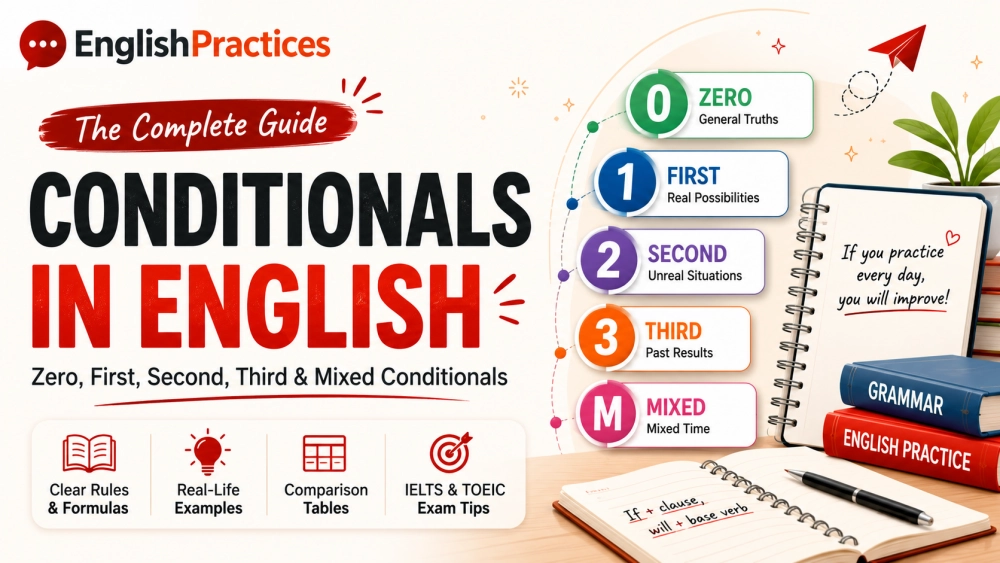
Quick Answer: A conditional sentence in English expresses what happens — or might happen — based on a specific condition. There are four main types (Zero, First, Second, Third) plus one Mixed type. Each uses a different verb tense combination in the "if-clause" and "main clause" to signal whether a situation is real, hypothetical, or imaginary.
Introduction
Most English learners treat conditionals as a grammar box to tick — something to memorise before an exam and promptly forget. That approach explains why so many B2 speakers still write "If I would study..." and why IELTS candidates consistently lose marks under Grammatical Range and Accuracy.
Conditionals are everywhere. They appear in job applications, university essays, business presentations, and everyday conversation across every English-speaking market — from London boardrooms to Seoul startup offices, from university campuses in Vietnam to corporate meetings in Mexico City. Getting them right does more than improve your grammar score; it genuinely changes how you communicate ideas, express opinions, and construct arguments.
This guide covers all five types of conditionals in English — Zero, First, Second, Third, and Mixed — with a clear formula, practical examples, and the most common errors that trip up learners globally. You will also find a quick-reference table, IELTS and TOEIC application tips, a full FAQ section, and an interactive quiz to test your understanding before you leave.
What you will learn:
- The structure and logic behind each conditional type
- How to choose the right tense in both clauses, every time
- The key differences between Second and Third Conditional
- How to use Mixed Conditionals for C1–C2 fluency
- Targeted strategies for IELTS Writing Task 2 and TOEIC Part 5
For a broader grammar foundation before diving in, the Complete English Grammar Guide at EP. is the recommended starting point for learners at every level.
What Are Conditionals in English?
A conditional sentence describes a relationship between a condition and a result. It always has two parts:
- The if-clause (condition): the situation that must occur
- The main clause (result): what follows as a consequence
If + [condition], [result]. [Result] + if + [condition].
Both clause orders are grammatically correct. When the if-clause comes first, a comma separates the two clauses. When the main clause leads, no comma is needed. This is a minor detail — but one that IELTS markers notice and grade.
There are four core types and one mixed type, each reflecting a different relationship between time and reality. Understanding that logic — not just memorising the formulas — is what makes conditionals click.
Quick Reference: All 5 Conditional Types at a Glance
| Type | Formula | Primary Use |
|---|---|---|
| Zero | If + Present Simple, Present Simple | Facts, habits, universal truths |
| First | If + Present Simple, will + base verb | Real, likely future situations |
| Second | If + Past Simple, would + base verb | Unreal or unlikely present/future |
| Third | If + Past Perfect, would have + past participle | Imaginary past situations |
| Mixed | If + Past Perfect / Past Simple, would + base / would have + past participle | Conditions and results across different time frames |
Zero Conditional: Facts That Never Change
The Zero Conditional is the foundational type. Use it to describe universal truths, scientific facts, and habitual cause-and-effect relationships — situations that happen every single time, without exception.
Formula: If + Present Simple, Present Simple.
Examples:
- If you heat water to 100°C, it boils.
- If I drink coffee after 8 PM, I cannot sleep.
- If humidity is high in Southeast Asia, the air feels heavy and dense.
A quick substitution test: in Zero Conditional sentences, you can replace "if" with "when" without changing the meaning. "When you heat water to 100°C, it boils." If that swap works naturally, you are dealing with a Zero Conditional — not a hypothetical scenario.
Most common mistake: placing "will" inside the if-clause.
- ✗ If you will heat water, it will boil.
- ✓ If you heat water to 100°C, it boils.
This error appears frequently in writing by learners in Vietnam, Thailand, and Japan — often because the equivalent structure in those languages does not signal this kind of tense constraint. In English, the if-clause in Zero Conditional always stays in Present Simple.
Zero Conditional is also essential in IELTS Academic Writing Task 1 for describing processes, trends, and cause-effect data. Understanding when to use it correctly builds directly on the tense foundation covered in EP.'s guide on Present Simple vs Present Continuous.
First Conditional: When Things Are Genuinely Possible
The First Conditional describes realistic future situations — conditions that could plausibly happen. The speaker considers the scenario likely or at least achievable.
Formula: If + Present Simple, will + base verb.
Examples:
- If you practise English every day, you will improve your fluency.
- If it rains during the match, the game will be cancelled.
- If she scores above 7.0 on IELTS, she will receive the scholarship.
The critical structural rule is the same as Zero Conditional: "will" never goes in the if-clause. The if-clause always uses Present Simple, regardless of how future the situation is. This trips up a significant number of intermediate learners because it feels counterintuitive when both clauses describe the future.
Adjusting certainty with modal verbs:
You are not locked into "will." Replacing it with "can," "may," or "might" shifts the degree of certainty:
- If you apply now, you can secure an early seat. → ability or opportunity
- If the weather clears, we may go to the beach. → possible, less certain
- If she joins the programme, she might get promoted. → uncertain but realistic
Imperative variation:
Using an imperative in the main clause creates instructional or advisory language — common in workplace emails, user manuals, and academic guidance:
- If you are confused about the assignment, ask your teacher immediately.
- If the system crashes, restart the application and log in again.
First Conditional in TOEIC Part 5:
TOEIC frequently tests whether you select "will" or "would" in the main clause. Identify the tense in the if-clause first: Present Simple → "will"; Past Simple → "would." That one rule eliminates the majority of conditional questions in TOEIC Part 5.
Second Conditional: Imagining a Different Reality
The Second Conditional is where grammar meets imagination. It describes situations that are hypothetical, unlikely, or contrary to present reality. The speaker is not predicting what will happen — they are exploring what would happen in an alternative world.
Formula: If + Past Simple, would + base verb.
Examples:
- If I had more hours in the day, I would read much more widely.
- If she were the CEO, she would change the company policy immediately.
- If we lived in Singapore, we would use English in every professional context.
The subjunctive: "were" vs "was"
In formal and written English, use "were" for all subjects — including I, he, she, it — when expressing hypothetical situations. This is the subjunctive mood, which signals unreality:
- ✓ If I were you, I would accept the offer.
- ✓ If the company were smaller, decisions would be faster.
- ✗ If I was you... — informal; avoid in IELTS Writing Band 7 and above
IELTS examiners specifically look for the subjunctive "were" as a marker of grammatical range. Using "was" in a formal essay signals limited accuracy.
Second vs. First Conditional: the likelihood principle
The choice between these two types is a deliberate judgment about how realistic you consider the situation. Compare:
| Your Belief About the Situation | Conditional | Example |
|---|---|---|
| Realistic — it could happen | First | If you work harder, you will get promoted. |
| Unlikely — probably won't happen | Second | If you worked harder, you would get promoted. |
Same subject, two different conditionals, two completely different meanings. This is a communication choice, not just a grammar rule.
Common error for Korean, Chinese, and Japanese learners:
Many learners correctly use Past Simple in the if-clause but then revert to "will" in the main clause: "If I had more time, I will study more." The main clause must always use "would," not "will." No exceptions.
Third Conditional: Rewriting What Could Have Been
The Third Conditional is the grammar of regret, missed opportunities, and alternative histories. It describes imaginary situations in the past — conditions that did not occur and results that, consequently, never happened.
Formula: If + Past Perfect, would have + past participle.
Examples:
- If I had prepared more thoroughly, I would have performed better in the interview.
- If the company had invested in staff training, employees would have stayed longer.
- If she hadn't missed the flight, she would have arrived on time and joined the meeting.
Both sides of the sentence refer to the past — the condition was not met in the past, and the imagined result also belongs to the past. That symmetry distinguishes Third Conditional from Mixed Conditionals, where one side references the present.
Varying the main clause with "could have" or "might have":
- If he had practised daily, he could have competed at a professional level. → ability
- If they had applied earlier, they might have been accepted. → uncertain outcome
The Past Perfect connection:
The if-clause uses the Past Perfect ("had + past participle"). If you are not fully confident with this tense, visit EP.'s guide on Past Simple vs Past Perfect before advancing. A shaky Past Perfect will consistently generate Third Conditional errors that are difficult to self-correct.
IELTS Writing Task 2 application:
Third Conditional fits naturally into essays that analyse historical decisions, past policies, or societal choices. A sentence such as "If governments had invested more in renewable energy during the 1990s, global emissions would have decreased significantly" demonstrates exactly the grammatical complexity that Band 7+ essays require. The tense patterns that make this work are also covered in EP.'s Present Perfect Tense guide — especially useful for learners moving from B1 to B2.
Mixed Conditionals: Advanced Grammar for Advanced Thinkers
Mixed Conditionals combine if-clauses and main clauses from different conditional types. They express situations where the condition and the result belong to different time periods — and that is precisely what makes them sophisticated.
Pattern 1: Past condition → Present result
If + Past Perfect (if-clause) + would + base verb (main clause).
Something did not happen in the past; as a result, the present is different.
- If I had chosen engineering over English, I would be a software developer today.
- If she hadn't relocated to the UK ten years ago, she wouldn't speak with a British accent now.
- If the company had invested in automation earlier, we would have a far more efficient operation today.
Pattern 2: Present/permanent condition → Past result
If + Past Simple (if-clause) + would have + past participle (main clause).
A current characteristic or reality explains why something did not happen in the past.
- If I were more disciplined, I would have finished the entire course months ago.
- If he weren't so reluctant to ask for help, he would have resolved the issue much faster.
Why Mixed Conditionals matter for IELTS Band 7+:
According to the IELTS Writing Band Descriptors published by the British Council and IDP, a Band 7 in Grammatical Range and Accuracy requires candidates to use "a variety of complex structures with some flexibility and accuracy." Mixed Conditionals are precisely the kind of structure examiners look for at this level — and in IELTS Speaking Part 3, they signal a natural command of English grammar rather than a memorised pattern.
For the tense foundations that underpin Mixed Conditionals — particularly perfect aspect structures — EP.'s Mastering Present Perfect guide is strongly recommended for learners moving from intermediate to advanced.
Top Conditional Mistakes — and How to Fix Them
These are the five most common errors across all conditional types, consistently seen in learners from Asia, Latin America, and the Middle East. Fixing these alone will produce a measurable improvement in both IELTS and TOEIC scores.
| The Mistake | Incorrect Form | Correct Form |
|---|---|---|
| "Will" in the if-clause | If you will come, I will help. | If you come, I will help. |
| "Would" in the hypothetical if-clause | If I would be rich, I would travel. | If I were rich, I would travel. |
| Past Simple instead of Past Perfect (Third Conditional) | If I studied harder, I would have passed. | If I had studied harder, I would have passed. |
| "Would have" inside the if-clause | If she would have called, I would have answered. | If she had called, I would have answered. |
| Missing comma after if-clause | If it rains we will cancel the event. | If it rains, we will cancel the event. |
The modal verb errors — particularly placing "will" or "would" in the if-clause — are the most penalised in both TOEIC and IELTS because they indicate a structural misunderstanding of how English conditionals work, not just a surface-level slip.
Conditionals in IELTS and TOEIC: Where Grammar Meets Results
For IELTS candidates:
The IELTS assessment criteria award marks under "Grammatical Range and Accuracy" at every band level. At Band 7, the descriptors explicitly require "a variety of complex structures." Using Second Conditional for opinion essays ("If governments were to invest more in public transport..."), Third Conditional for historical analysis ("If stricter regulations had been enforced earlier..."), and Mixed Conditionals for nuanced argumentation is one of the most efficient ways to push your Writing and Speaking scores upward.
In IELTS Speaking Part 3, examiners ask speculative questions by design: "What do you think would happen if...?" A well-formed Second or Third Conditional response signals both fluency and grammatical range in a way that simple present-tense answers cannot match.
For TOEIC candidates:
TOEIC Part 5 presents incomplete sentences where you must select the correct verb form. The strategy is straightforward: identify the tense in the if-clause first, then select the matching main clause form. Present Simple in the if-clause → "will" in the main clause. Past Simple in the if-clause → "would" in the main clause. Practise the patterns until recognition becomes automatic rather than calculated.
For everyday English learners:
Whether you are working in Singapore, studying in the UK, or communicating with international clients from Korea, Japan, Mexico, or China — conditionals appear constantly in professional and social English. The more you encounter them passively through reading and listening, and use them actively in writing and conversation, the more natural they become. Confident use of conditionals is a genuine milestone on the path from B2 to C1.
For a complete overview of where conditionals fit within the full grammar system, the Complete English Grammar Guide at EP. maps every major grammar area into a clear learning path.
Conclusion: Make Conditionals Work for You
Conditionals are not just grammar rules — they are the way English speakers express possibility, regret, caution, and imagination. Once you understand the underlying logic (the relationship between time frame and reality frame), choosing the right conditional stops feeling like a guess and starts feeling like a deliberate choice.
Your five-step action plan:
- Memorise the five formulas using the Quick Reference Table above.
- Write at least five original sentences for each conditional type, drawn from real situations in your life or career.
- Identify conditionals in English articles, podcasts, and emails you read this week — notice the type and the time frame.
- Complete the quiz below to pinpoint your weak areas before your next study session.
- Return to any gaps using the EP. grammar guides linked throughout this article.
Whether you are preparing for IELTS, working through TOEIC practice sets, writing a business proposal for a UK client, or simply aiming to sound more natural in everyday English — conditionals are one of the highest-leverage grammar areas you can master. The investment is modest; the payoff is lasting.
Explore the full grammar library at EnglishPractices.com and continue building your conditional fluency with real, structured practice today.