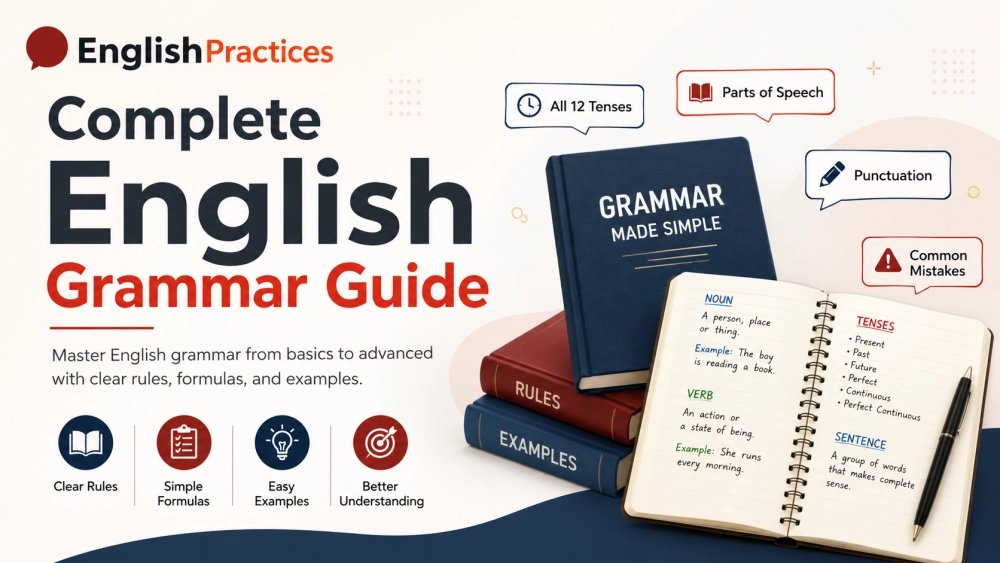
English grammar is the system of rules that shapes every sentence you write, every email you send, and every exam answer you submit. Whether you are preparing for IELTS in Seoul, writing a business report in Ho Chi Minh City, or studying for TOEIC in Bangkok, grammar accuracy is the difference between being understood and being misunderstood.
This complete English grammar guide covers the eight parts of speech, sentence structure, all 12 verb tenses with formulas and examples, subject-verb agreement, punctuation rules, and the most common mistakes learners make — all explained in plain, clear English. According to the British Council, approximately 1.5 billion people are currently learning English worldwide. That means grammar fluency has never carried more professional and academic weight than it does right now.
You will move through this guide in a logical sequence — from foundational concepts to advanced structures — with tables, formulas, and real examples at every step.
Use the quick-navigation table below to jump directly to the section most relevant to you.
| Section | Best For |
|---|---|
| What Is English Grammar? | Absolute beginners |
| Parts of Speech | Beginners to intermediate |
| English Sentence Structure | Intermediate learners |
| English Verb Tenses | All levels — high IELTS/TOEIC value |
| Subject-Verb Agreement | Intermediate to advanced |
| Punctuation Rules | Writers, exam takers |
| Common Grammar Mistakes | All levels |
| Tips to Improve Faster | Self-directed learners |
| Best Resources | All levels |
| FAQ | Quick reference |
What Is English Grammar?
English grammar is the complete set of structural rules that govern how words combine to form meaningful sentences. Think of it as the operating system of the language — without it, words are just noise arranged in no particular order.
Grammar matters beyond exam scores. It affects how people perceive your intelligence, professionalism, and credibility in every context — from a job interview in Singapore to a university application in the UK. A single misplaced comma or an incorrect verb form can change the meaning of a sentence entirely.
Consider these examples:
| Incorrect | Correct | What changes |
|---|---|---|
| Let's eat children. | Let's eat, children. | The comma saves lives — literally |
| She don't like coffee. | She doesn't like coffee. | Subject-verb agreement |
| I seen him yesterday. | I saw him yesterday. | Irregular past tense |
Grammar is also systematic, and that is the good news. Once you understand the core rules, you can apply them across thousands of different sentences without memorizing each one individually. This is what makes a strategic approach to grammar learning so effective — you build a mental framework, not just a list of rules.
Why Grammar Matters in 2026: A Global Perspective
The EF English Proficiency Index (EF EPI), an annual ranking that measures English skills across non-native speaking countries, consistently shows growth across Asia — particularly in Vietnam, South Korea, Japan, and Singapore. English proficiency in these markets has become a key differentiator in competitive job markets and academic admissions.
| Region | Key Driver for Grammar Study |
|---|---|
| UK & North America | Professional communication, academic writing |
| South Korea & Japan | TOEIC exam preparation, corporate English |
| Vietnam & Thailand | IELTS preparation, university admissions |
| Mexico & Latin America | Business communication, bilingual career paths |
| China & Singapore | High-stakes academic and professional settings |
EnglishPractices.com has helped students across all of these markets build grammar competence that goes beyond passing a test — the kind that supports real communication for years.
Parts of Speech in English Grammar
Every word in the English language belongs to one of eight grammatical categories called parts of speech. These are the fundamental building blocks of all sentences. Understanding each one gives you precise control over how you express ideas — and why certain sentences feel right while others feel off.
Nouns
A noun names a person, place, thing, or idea. Every sentence contains at least one.
Types of Nouns:
| Type | Definition | Example |
|---|---|---|
| Proper noun | Names a specific person, place, or brand | London, Maria, Google |
| Common noun | Names a general category | city, person, company |
| Countable noun | Can be counted individually | apple, chair, mistake |
| Uncountable noun | Cannot be individually counted | water, advice, information |
Rules for Common Noun Errors:
| Rule | Correct Example | Common Error |
|---|---|---|
| Uncountable nouns have no plural form | "I need some advice." | "I need some advices." |
| Proper nouns are always capitalized | "She lives in Paris." | "She lives in paris." |
| Countable plurals add -s or -es | "Three mistakes were found." | "Three mistake was found." |
Words like luggage, furniture, news, knowledge, and equipment are uncountable in English. You cannot say "a luggage" — the correct form is "a piece of luggage." This is a persistent error for learners whose first language treats these as countable nouns.
Pronouns
A pronoun replaces a noun to avoid repetition and keep sentences flowing naturally.
The Four Main Pronoun Types:
| Type | Pronouns | Example |
|---|---|---|
| Subject pronouns | I, you, he, she, it, we, they | She called the office. |
| Object pronouns | me, you, him, her, it, us, them | The manager called her. |
| Possessive pronouns | mine, yours, his, hers, ours, theirs | That report is mine. |
| Reflexive pronouns | myself, yourself, himself, themselves | He revised the essay himself. |
Common Pronoun Error — Mixing Subject and Object:
- ❌ "Between you and I, the meeting went poorly."
- ✅ "Between you and me, the meeting went poorly."
The rule: subject pronouns (I, she, he) go before the verb; object pronouns (me, her, him) follow a verb or preposition.
Verbs
Verbs express actions, states, or occurrences. Every complete sentence requires at least one verb.
Three Main Verb Types:
| Type | Function | Examples |
|---|---|---|
| Action verbs | Express physical or mental actions | run, write, decide, think |
| Linking verbs | Connect the subject to a description | is, are, seem, become, appear |
| Helping (auxiliary) verbs | Support the main verb | have, do, will, can, must, should |
Subject-Verb Agreement — The Core Rule:
Singular subjects take singular verbs. Plural subjects take plural verbs.
- ✅ "The student studies every day."
- ✅ "The students study every day."
- ❌ "The student study every day."
Adjectives and Adverbs
An adjective describes a noun. An adverb modifies a verb, adjective, or another adverb. They look similar and function in related ways, which is exactly why learners confuse them.
The Core Distinction:
| Incorrect | Correct | Why |
|---|---|---|
| "She sings beautiful." | "She sings beautifully." | Modifies a verb → adverb needed |
| "He runs very quick." | "He runs very quickly." | Modifies a verb → adverb needed |
| "That is a well decision." | "That is a good decision." | Modifies a noun → adjective needed |
Comparative and Superlative Forms:
| Base Adjective | Comparative | Superlative | Rule |
|---|---|---|---|
| fast | faster | fastest | Short adjectives: add -er / -est |
| beautiful | more beautiful | most beautiful | 2+ syllables: use more / most |
| good | better | best | Irregular — must be memorized |
| bad | worse | worst | Irregular — must be memorized |
Prepositions, Conjunctions, and Interjections
Prepositions show relationships between words — most often time, place, or direction.
The three most confused prepositions of time are at, on, and in:
| Preposition | Usage | Example |
|---|---|---|
| at | Specific clock times | "The exam starts at 9 a.m." |
| on | Days and specific dates | "The exam is on Monday." / "on July 4th" |
| in | Months, years, and longer periods | "She enrolled in March." / "in 2026" |
Conjunctions join words, phrases, or clauses. The seven coordinating conjunctions are remembered by the acronym FANBOYS:
For · And · Nor · But · Or · Yet · So
- "She studied intensively, but the reading section was still difficult."
- "You can practice grammar online or work through a textbook."
Subordinating conjunctions (because, although, while, since, unless, when) introduce dependent clauses:
- "Although she was nervous, she performed well on the exam."
- "He improved quickly because he practiced every day."
Interjections express emotion and stand alone grammatically: Wow! Oh! Hey! Oops! They are rarely tested in formal exams but appear frequently in everyday conversation.
English Sentence Structure
A grammatically complete English sentence requires at minimum one subject and one verb. Getting sentence structure right is what separates fluent communication from confusing output — and it is one of the fastest areas to improve with targeted practice.
Basic Sentence Formula
The standard English sentence follows this structure:
Subject + Verb + Object (SVO)
| Part | Role | Example |
|---|---|---|
| Subject | Who or what performs the action | The teacher |
| Verb | The action or state | explained |
| Object | Who or what receives the action | the grammar rule |
Full sentence: "The teacher explained the grammar rule."
You can expand this pattern with modifiers and phrases:
- Minimal: "She reads."
- Expanded: "She reads English grammar guides every morning before work."
Two Common Structural Errors:
- ❌ "Goes to school every day." (missing subject — sentence fragment)
- ✅ "He goes to school every day."
- ❌ "The cat sat. On the mat." (second part is a fragment — no subject or complete verb)
- ✅ "The cat sat on the mat."
Types of Sentences
| Type | Structure | Example |
|---|---|---|
| Simple | One independent clause | "She passed the exam." |
| Compound | Two independent clauses joined by a conjunction | "She studied hard, and she passed the exam." |
| Complex | One independent clause + one dependent clause | "Because she studied hard, she passed the exam." |
| Compound-Complex | Two independent clauses + one dependent clause | "She studied hard, so she passed, although it was a challenge." |
Varying sentence type is a core skill in IELTS Writing Task 2 and academic English. Examiners reward grammatical range — which means using all four types deliberately, not defaulting to simple sentences throughout.
English Verb Tenses Explained
English has 12 tenses organized across three time frames — present, past, and future — each with four aspects: simple, continuous, perfect, and perfect continuous. This is often the area where learners feel most stuck, because English tense usage depends on context and meaning, not just time. The system is logical once you see the pattern.
Present Tenses
- Simple Present
| Element | Detail |
|---|---|
| Formula | Subject + base verb (+s/es for he/she/it) |
| Usage | Habits, general truths, routines, scheduled events |
| Example | "She studies grammar every morning." |
| Signal words | always, usually, often, sometimes, never, every day |
| Common mistake | ❌ "She study grammar." → ✅ "She studies grammar." (missing -s for third-person singular) |
- Present Continuous
| Element | Detail |
|---|---|
| Formula | Subject + am/is/are + verb-ing |
| Usage | Actions in progress right now, temporary situations |
| Example | "She is studying grammar right now." |
| Signal words | now, at the moment, currently, this week |
| Common mistake | ❌ "I am knowing the answer." → ✅ "I know the answer." (stative verbs do not use continuous form) |
Read More: Present Simple vs Present Continuous: The Complete Guide
| Element | Detail |
|---|---|
| Formula | Subject + have/has + past participle |
| Usage | Actions with a connection to the present, life experiences, recent past |
| Example | "She has completed three grammar units today." |
| Signal words | already, yet, just, ever, never, recently, since, for |
| Common mistake | ❌ "I have seen him yesterday." → ✅ "I saw him yesterday." (specific past time → use simple past) |
See more about Present Perfect at Mastering Present Perfect
- Present Perfect Continuous
| Element | Detail |
|---|---|
| Formula | Subject + have/has + been + verb-ing |
| Usage | Ongoing actions that started in the past and continue now; emphasis on duration |
| Example | "She has been studying grammar for two hours." |
| Signal words | for, since, all day, how long |
| Common mistake | ❌ "She has been finishing the book." → ✅ "She has finished the book." (use perfect, not continuous, for completed actions) |
Past Tenses
- Simple Past
| Element | Detail |
|---|---|
| Formula | Subject + past tense verb (regular: +ed; irregular: vary by verb) |
| Usage | Completed actions at a specific point in the past |
| Example | "She studied grammar last night." |
| Signal words | yesterday, last week, in 2022, ago, when |
| Common mistake | ❌ "She studyed." → ✅ "She studied." (consonant + y → ied) |
- Past Continuous
| Element | Detail |
|---|---|
| Formula | Subject + was/were + verb-ing |
| Usage | Action in progress when another event occurred; two parallel past actions |
| Example | "She was studying when her phone rang." |
| Signal words | while, when, as, at that moment |
| Common mistake | Using simple past instead changes meaning: "She studied when her phone rang" implies a sequence, not an interruption |
Read More: Past Simple vs Past Perfect: When to Use Each (With Examples)
- Past Perfect
| Element | Detail |
|---|---|
| Formula | Subject + had + past participle |
| Usage | An action completed before another past action |
| Example | "She had studied all the tenses before the exam began." |
| Signal words | already, before, by the time, after, once, when |
| Common mistake | Overusing it when simple past is sufficient; use it only when the sequence matters |
- Past Perfect Continuous
| Element | Detail |
|---|---|
| Formula | Subject + had + been + verb-ing |
| Usage | Duration of an activity up to a specific point in the past |
| Example | "She had been studying for three hours when the power cut." |
| Signal words | for, since, before, when |
| Common mistake | Confusing with past perfect: the continuous form emphasizes the duration of the action, not just its completion |
Future Tenses
- Simple Future (will)
| Element | Detail |
|---|---|
| Formula | Subject + will + base verb |
| Usage | Spontaneous decisions, predictions, promises, offers |
| Example | "I will call you tomorrow." |
| Signal words | tomorrow, next week, soon, in the future, I think... |
| Common mistake | ❌ "I will to call you." → ✅ "I will call you." (never use to after will) |
- Future with "Going To"
| Element | Detail |
|---|---|
| Formula | Subject + am/is/are + going to + base verb |
| Usage | Pre-planned intentions, predictions based on evidence |
| Example | "She is going to take the IELTS exam next month." |
| Signal words | this weekend, next month, soon, I'm planning to... |
| Common mistake | Interchanging with will when a decision was made in advance — going to signals a prior plan |
- Future Continuous
| Element | Detail |
|---|---|
| Formula | Subject + will + be + verb-ing |
| Usage | An action that will be in progress at a specific future time |
| Example | "This time tomorrow, she will be sitting her grammar exam." |
| Signal words | this time tomorrow, at 8 p.m. tonight, next month at this point |
| Common mistake | Many learners skip this tense entirely — it appears in IELTS listening and reading comprehension more than most expect |
- Future Perfect
| Element | Detail |
|---|---|
| Formula | Subject + will + have + past participle |
| Usage | An action completed before a specific point in the future |
| Example | "By December, she will have studied all 12 grammar tenses." |
| Signal words | by (time), before (time), by the time |
| Common mistake | ❌ "By next year, I will finish." → ✅ "By next year, I will have finished." |
Subject-Verb Agreement Rules
Subject-verb agreement means the verb must match its subject in both number (singular or plural) and person. Break this rule and your sentence sounds immediately wrong — to native speakers, advanced learners, and exam examiners alike.
Core Rules:
| Rule | Correct Example | Common Error |
|---|---|---|
| Singular subject → singular verb | "The student studies every night." | "The student study every night." |
| Plural subject → plural verb | "The students study every night." | "The students studies every night." |
| Collective nouns (singular in meaning) | "The team is playing well." | "The team are playing well." (note: British English sometimes accepts plural here) |
| Indefinite pronouns take singular verbs | "Everyone is welcome to join." | "Everyone are welcome to join." |
| Subjects joined by and → plural verb | "Tom and Sarah are presenting today." | "Tom and Sarah is presenting today." |
| Either/or, neither/nor → verb agrees with nearer subject | "Neither the teacher nor the students are ready." | "Neither the teacher nor the students is ready." |
The Intervening Phrase Trap:
When a phrase sits between the subject and the verb, do not let it pull you away from the real subject.
- ❌ "The list of grammar rules are helpful."
- ✅ "The list of grammar rules is helpful." — list is the subject, not rules
This error appears consistently in IELTS Writing and TOEIC test scripts from learners across every market. Identifying the true subject before selecting the verb is the most reliable technique to avoid it.
English Punctuation Rules
Punctuation controls rhythm, clarity, and meaning. A misplaced comma or a missing apostrophe does not just look careless — it changes what the sentence means, and sometimes dramatically.
Commas
Use commas to:
- Separate items in a list: "She reviewed grammar, vocabulary, pronunciation, and fluency."
- Join two independent clauses with a coordinating conjunction: "She studied hard, but the listening section was still a challenge."
- Follow introductory phrases: "After the exam, she reviewed every mistake carefully."
- Enclose non-essential information: "Her teacher, Mr. Kim, explained the rule three times."
The Comma Splice — The Most Common Punctuation Error:
- ❌ "She loves grammar, it is her favorite subject."
- ✅ "She loves grammar. It is her favorite subject." or "She loves grammar**, and** it is her favorite subject."
A comma cannot join two independent clauses alone. You need a conjunction, a semicolon, or a period.
Apostrophes
| Use | Example |
|---|---|
| Contraction | don't = do not · it's = it is · they're = they are |
| Singular possession | the student's* book* |
| Plural possession | the students'* books* |
Never use an apostrophe for plurals.
- ❌ "Two apple's on the table."
- ✅ "Two apples on the table."
Colons and Semicolons
| Punctuation | Use | Example |
|---|---|---|
| Colon ( : ) | Introduce a list or explanation | "She needed three things: focus, time, and a grammar guide." |
| Semicolon ( ; ) | Join two closely related independent clauses | "She passed the exam; her preparation paid off." |
Quotation Marks
Use double quotation marks for direct speech and titles of short works.
- American English: punctuation goes inside the quotation marks.
- British English: punctuation goes outside if it is not part of the quoted material.
Common English Grammar Mistakes and How to Fix Them
These are the errors that appear most consistently across learner writing globally — in IELTS scripts, TOEIC writing sections, and professional emails from Bangkok to Mexico City to Seoul.
| Incorrect | Correct | Why |
|---|---|---|
| "Their going to the store." | "They're going to the store." | Their is possessive; they're = they are |
| "Your welcome." | "You're welcome." | Your is possessive; you're = you are |
| "The dog wagged it's tail." | "The dog wagged its tail." | It's = it is; its = belonging to it |
| "The news effect me deeply." | "The news affects me deeply." | Affect is the verb; effect is the noun |
| "I don't know nothing." | "I don't know anything." | Double negatives cancel each other in standard English |
| "She is more taller than him." | "She is taller than him." | Do not combine more with an -er comparative |
| "I have went to the store." | "I have gone to the store." | Past participle of go is gone, not went |
| "He work here since 2019." | "He has worked here since 2019." | Since requires present perfect, not simple present |
| "They are agree with the plan." | "They agree with the plan." | Agree is not used with be as a linking verb |
| "She explained me the rule." | "She explained the rule to me." | Explain does not take a direct indirect object |
These mistakes arise largely from direct translation — applying the grammatical structure of a first language (Vietnamese, Korean, Japanese, Thai, Spanish, Mandarin) to English. That is a completely natural part of the learning process. Grammar study makes you aware of the points where English diverges from your first language, which is where the real progress happens.
Tips to Improve English Grammar Faster
Knowing a rule is step one. Using it automatically under pressure — in a timed exam or a professional meeting — is the goal. Here is a practical, strategic approach to getting there.
- Learn rules in context, not in isolation.
Do not memorize "have/has + past participle = present perfect" as a formula alone. Read it in authentic sentences, hear it in podcasts, and see it in real emails. Pattern recognition builds faster and lasts longer than memorization. - Write every day — even a single paragraph.
Daily writing forces you to apply rules actively rather than passively recognize them. Keep a journal in English, respond to news articles, or write summaries of things you read. Frequency matters more than length. - Read extensively from quality English sources.
BBC News, The Guardian, The New York Times, and academic journals all maintain rigorous editorial grammar standards. Reading them regularly exposes you to grammatically correct sentences in natural, varied context. - Use grammar tools with learning intent.
Grammarly and ProWritingAid are innovative solutions for self-directed learners — but only if you read the explanations, not just accept the corrections. Every suggested fix is a free grammar lesson. This approach optimizes your time and your learning performance simultaneously, making it one of the most efficient daily habits you can build. - Keep an error log and review it weekly.
When you make a grammar mistake — in writing, on an exam, or in a grammar checker correction — write it down. Record the error, the correct form, and the rule. Review the log weekly. You will identify your personal error patterns within two to three weeks, which is exactly where focused study delivers the fastest results. - Take a strategic approach to exam preparation.
For IELTS and TOEIC, grammar contributes directly to your score in reading, writing, and listening sections. The TOEIC exam, administered by ETS, is taken by approximately 7 million candidates per year globally according to ETS official data. Identifying which tenses, agreement rules, and sentence types appear most frequently in the exam format — and prioritizing those first — is studying smarter, not harder. - Practice with structured exercises.
Targeted exercises that require you to produce correct sentences from scratch (not just identify errors in multiple choice) build writing accuracy faster. See Free Grammar Practice Articles for sets organized by grammar topic and level.
Best Resources to Learn English Grammar
You do not need to spend heavily to access excellent grammar resources. What matters is accuracy, clarity, and structure — whether the resource is a book, an app, or a guided course.
Recommended Reference Books:
| Book | Author | Best For |
|---|---|---|
| English Grammar in Use | Raymond Murphy (Cambridge) | Intermediate learners worldwide |
| Advanced Grammar in Use | Martin Hewings (Cambridge) | C1/C2 level, IELTS preparation |
| Practical English Usage | Michael Swan (Oxford) | Specific grammar question reference |
Recommended Digital Tools:
- Grammarly — real-time grammar and clarity checking across browsers, Word, and Google Docs; free and premium tiers available
- ProWritingAid — detailed grammar reports particularly suited to academic and long-form professional writing
⚡ Take the Next Step with EnglishPractices.com
This guide gives you the complete framework. Now it is time to apply it. Explore the full grammar lesson library at EnglishPractices.com — organized by topic, level, and exam type — or bring your specific grammar question to the EP team directly. We have helped learners across 15+ countries move from uncertain to confident in English. Start Learning with EP.
Conclusion: Building Grammar That Lasts
English grammar is a learnable, structured system — one that rewards consistent study, deliberate practice, and genuine curiosity about how language works. Every tense formula you internalize, every comma rule you apply correctly, and every common mistake you learn to avoid brings you measurably closer to confident, clear communication.
This complete English grammar guide has given you the foundational framework: the eight parts of speech, four types of sentences, all 12 verb tenses with formulas and examples, subject-verb agreement rules, punctuation standards, common global learner mistakes, and a practical improvement strategy built around real writing habits.
That is the starting point. The ceiling is wherever your ambition takes you.
The approach at EnglishPractices.com is straightforward: clear explanations, real examples, and structured resources that support learners from beginner level through advanced exam preparation — across the UK, North America, Southeast Asia, East Asia, and beyond. No jargon. No complexity for its own sake. Just grammar that makes sense.
Explore the full grammar library at EnglishPractices.com and take your next step toward fluency today.
Published by EnglishPractices.com | Grammar | Last updated: June 2026
Sources referenced: British Council (English language learner estimates), ETS TOEIC (annual candidate volume), EF English Proficiency Index (annual regional rankings), Cambridge University Press (grammar reference titles).