The Grammar Question That Costs Exam Marks — and How to Settle It for Good
If you have ever written "I ate before she arrived" and wondered whether it should be "I had eaten before she arrived" — you are not alone. This single distinction trips up learners at every level, from beginners in Bangkok to advanced IELTS candidates in Seoul. And because both sentences look perfectly reasonable at first glance, the confusion tends to stick around far longer than it should.
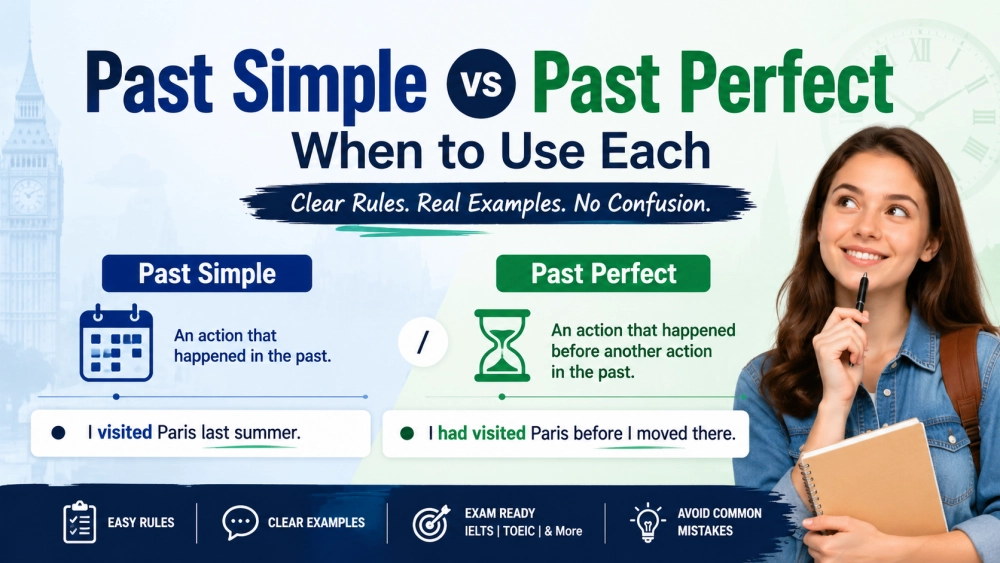
Here is the direct answer: Use the past simple for a completed action at a known time in the past. Use the past perfect when one past action happened before another past action, and you need to make that order unmistakable. One tense places you in the past. The other places you further back in the past.
That distinction sounds small. In practice, choosing the wrong tense changes your meaning — and in IELTS Writing or TOEIC grammar questions, it directly affects your score.
This guide covers both tenses completely: what they are, how they are formed, when to use each, common mistakes learners make globally, and a decision framework you can use the next time you sit down to write.
Quick Answer
Past Simple = Subject + past verb form → She left the office. Past Perfect = Subject + had + past participle → She had left before I arrived. Core rule: When two past actions appear in the same sentence, the earlier action takes the past perfect. The later action takes the past simple.
What Is the Past Simple? Structure, Uses, and Clear Examples
The past simple — also called the simple past tense — is the most commonly used past tense in English. It describes an action that started and finished at a specific point in the past, whether that point is stated explicitly or clear from context.
Structure: Subject + past form of verb (regular or irregular)
- Regular verbs add -ed: walk → walked, call → called, finish → finished
- Irregular verbs change form: go → went, buy → bought, see → saw, have → had
Examples in use:
- She called her manager yesterday.
- They travelled to Tokyo in 2022.
- I finished the report before the meeting.
- He didn't reply for three days.
The past simple answers the question: What happened?
It works as your default tense for storytelling, news reporting, and recounting events in sequence. Time expressions like yesterday, last week, in 2019, three months ago, and when are reliable signals that the past simple belongs in that sentence.
Common Time Markers for the Past Simple
| Time Expression | Example Sentence |
|---|---|
| yesterday / last week | She submitted the form yesterday. |
| in [year] / in [month] | He moved to London in 2021. |
| [number] ago | They met three years ago. |
| when | When she called, I was working. |
What Is the Past Perfect? Structure, Uses, and Clear Examples
The past perfect describes an action that was completed before a specific point in the past. Think of it as the "past of the past" — it takes you one step further back on the timeline than the past simple.
Structure: Subject + had + past participle
| Subject | Auxiliary | Past Participle | Example |
|---|---|---|---|
| I / You / He / She / We / They | had | finished | I had finished my homework before dinner. |
| Negative | hadn't | left | They hadn't left when we arrived. |
| Question | Had | seen | Had she seen the email before the meeting? |
The past perfect answers a different question: What had already happened before something else occurred in the past?
This tense becomes essential the moment two past events appear in the same sentence and their order matters. Without the past perfect, readers must guess which event came first — which is a problem in both everyday communication and formal writing.
Common Time Markers for the Past Perfect
- before, after, by the time, already, just, never, once, as soon as
- "By the time she arrived, we had already started."
- "He had never visited London before that trip."
- "Once I had understood the rule, everything fell into place."
The Core Difference: Two Events, Two Positions on the Timeline
Here is where most learners reach a real turning point. Picture two separate events, both in the past. You need a way to show which one happened first.
Event A happened first → use the past perfect Event B happened second → use the past simple
Look at this pair of sentences:
❌ "When I arrived, she left." ✓ "When I arrived, she had already left."
The first sentence implies both actions happened at roughly the same time. The second clearly shows she left before I arrived. The past perfect signals the earlier event, and the meaning becomes unambiguous.
Now consider this sentence:
"I ate dinner, then I watched a film."
Here, you do not need the past perfect at all, because the word then already makes the sequence obvious. Both verbs stay in the past simple — and that is entirely correct. The past perfect is not a "more formal" version of the past simple; it carries a specific meaning, and you only use it when that meaning is needed.
Side-by-Side Comparison: Past Simple vs Past Perfect
| Feature | Past Simple | Past Perfect |
|---|---|---|
| Formula | V2 (walked, went, saw) | had + V3 (had walked, had gone, had seen) |
| Time reference | A specific past time | Before another past event |
| Sequence signal | Not required | Required when order is ambiguous |
| Common time markers | yesterday, ago, last week, in [year] | before, after, already, by the time, once |
| Narrative role | Main story events | Background events, prior context |
| Negative form | didn't + base verb | hadn't + past participle |
| Question form | Did + subject + base verb? | Had + subject + past participle? |
When to Use the Past Simple: Four Reliable Cases
1. A Single Completed Action With a Known Time
The most fundamental use. Something happened, and it is now done.
- She submitted her application last Tuesday.
- He called three times but got no answer.
2. A Series of Past Events Told in Sequence
For storytelling, the past simple handles events that follow each other in chronological order.
- She woke up, made coffee, and opened her laptop.
The sequence is clear from narrative flow alone, so no past perfect is necessary.
3. A Past Habit or Repeated Action
- He walked to school every morning.
- They visited their grandparents every summer.
4. A State That Existed in the Past
- I lived in Hanoi for three years.
- She knew him well before the project started.
When to Use the Past Perfect: Four Reliable Cases
1. To Show One Past Action Happened Before Another
This is the primary use and the one most frequently tested in IELTS and TOEIC.
- By the time the doctor arrived, the patient had already recovered.
- I realised I had forgotten my passport when I reached the airport.
In both sentences, the past perfect marks the earlier event. The past simple marks the later one. The structure is clean and precise.
2. Reported (Indirect) Speech Shifting Backward in Time
When moving direct speech into the past, the verb tenses shift back by one step. Past simple becomes past perfect.
- Direct: "I finished the report."
- Reported: She said she had finished the report.
3. Third Conditional Sentences (If Clause)
In third conditional structures, the past perfect always appears in the if clause.
- If I had studied harder, I would have passed the exam.
- If she had arrived earlier, she would have met him.
4. An Unfulfilled Past Expectation or Intention
- I had hoped to finish by noon, but the work took longer.
- She had planned to visit, but the flight was cancelled.
Common Mistakes Learners Make — and How to Correct Them
These errors appear consistently in IELTS scripts, TOEIC practice tests, and writing from learners across Vietnam, South Korea, Japan, Mexico, China, and beyond. Recognising them in your own writing is half the battle.
Mistake 1: Using Past Simple When Sequence Is Ambiguous
❌ "When he arrived, she already left." ✓ "When he arrived, she had already left."
The word already is a strong signal that the past perfect belongs here. The past simple makes the sentence grammatically possible but logically vague.
Mistake 2: Overusing the Past Perfect When Connectors Make Order Clear
❌ "First, I had eaten breakfast, and then I had gone to work." ✓ "First, I ate breakfast, and then I went to work."
When words like first, then, after that, and next already establish the sequence, the past simple is the correct and more natural choice for both verbs. Adding the past perfect here sounds over-formal and is grammatically unnecessary.
Mistake 3: Assuming Before/After Always Requires the Past Perfect
Learners from Thailand, Singapore, and China frequently ask: "If the sentence contains before, do I always need the past perfect?"
Not necessarily. Before and after already establish which event came first, so the past simple works in both clauses:
- I finished lunch before she arrived. ← grammatically correct
- I had finished lunch before she arrived. ← also correct, emphasises completion
Both are valid. The past perfect version is preferred in formal writing and exam contexts because it adds clarity about completion, and IELTS examiners reward that precision.
Mistake 4: Incorrect Negative and Question Forms
❌ "Did he had seen the film?" ✓ "Had he seen the film?"
The past perfect uses had/hadn't directly — never did/didn't. This is a structural rule, and it applies without exception.
Past Simple vs Past Perfect in IELTS and TOEIC: What the Examiners Look For
Grammar accuracy is a scored criterion in both exams, and tense precision plays a measurable role. According to the British Council's published IELTS band descriptors, candidates who demonstrate a varied and accurate range of grammatical structures — including past perfect — achieve higher scores in the Grammatical Range and Accuracy category. A Band 7 writer uses complex sentences correctly; a Band 8 or 9 writer uses them with consistent precision.
In TOEIC, Part 5 (Incomplete Sentences) and Part 6 (Text Completion) regularly test tense selection. Questions often hinge on a single time marker — already, by the time, before — that points clearly to one tense. Missing that marker is the difference between a correct and incorrect answer.
The exam-ready rule: When a sentence contains two past actions and includes before, after, by the time, already, once, just, or when, the earlier action takes the past perfect and the later action takes the past simple.
IELTS Writing Task 2 example at Band 7+ level:
"Many students struggled academically because they had not developed strong study habits before entering university."
Here, had not developed (past perfect) occurred before struggled (past simple). That sentence structure demonstrates grammatical range and earns marks.
Decision Framework: Which Tense Do I Choose?
Use this step-by-step process whenever you are unsure:
- Is the action in the past? → Yes → Continue.
- Is there only one past event? → Use the past simple.
- Are there two past events in the same sentence?
- Identify which happened first → past perfect (had + past participle)
- Identify which happened second → past simple (V2)
- Is the order already obvious from connectors like first, then, after that? → Past simple works for both verbs.
- Does the sentence include already, by the time, just, never, once, as soon as? → Strongly favour the past perfect for the earlier event.
Real-World Examples Across Contexts
Academic writing: Researchers confirmed that the trend had begun decades earlier.
Business email: By the time the team met on Friday, the client had already approved the budget.
Everyday conversation: I couldn't find my keys because I had left them in the car.
IELTS narrative essay: The meeting was tense. Nobody mentioned what had happened the week before.
Each of these follows the same logic: the past perfect marks what came first, and the past simple marks what came after. Once you internalise that pattern, it becomes automatic.
Summary Table: Which Tense to Use at a Glance
| Situation | Tense to Use |
|---|---|
| One past action, time is clear | Past Simple |
| Earlier of two past actions | Past Perfect |
| Later of two past actions | Past Simple |
| Reported speech (shifting back) | Past Perfect |
| Third conditional (if clause) | Past Perfect |
| Past habit or repeated action | Past Simple |
| Past state that no longer exists | Past Simple |
| Unfulfilled past expectation | Past Perfect |
EnglishPractices.com: Grammar Precision, Built on 19 Years of Teaching Experience
The difference between past simple and past perfect is not a minor technicality. It shapes how clearly your ideas come across — in exams, in professional emails, and in everyday conversations whether you are in Hanoi, London, Seoul, or Mexico City.
The rule itself is straightforward: use the past perfect for the earlier of two past events, and the past simple for the later one. What takes genuine practice is recognising the moments when sequence matters, and building the reflex to choose the right tense without stopping to analyse every sentence.
At EP — EnglishPractices.com — we have spent 19+ years helping learners across the UK, North America, Southeast Asia, and East Asia build exactly that kind of grammatical precision. The approach here is not about drilling rules in isolation. It is about understanding why a sentence works, so that you write and speak with real confidence from day one.
Whether you are preparing for IELTS, studying for TOEIC, or simply want your written English to reflect the quality of your thinking, the grammar resources at EnglishPractices.com are built around your goals — practical, structured, and grounded in real exam experience.
Ready to sharpen your grammar? Browse the full grammar resource library at EnglishPractices.com, or reach out to the team to discuss a structured learning plan tailored to your exam date, your level, and your ambitions.