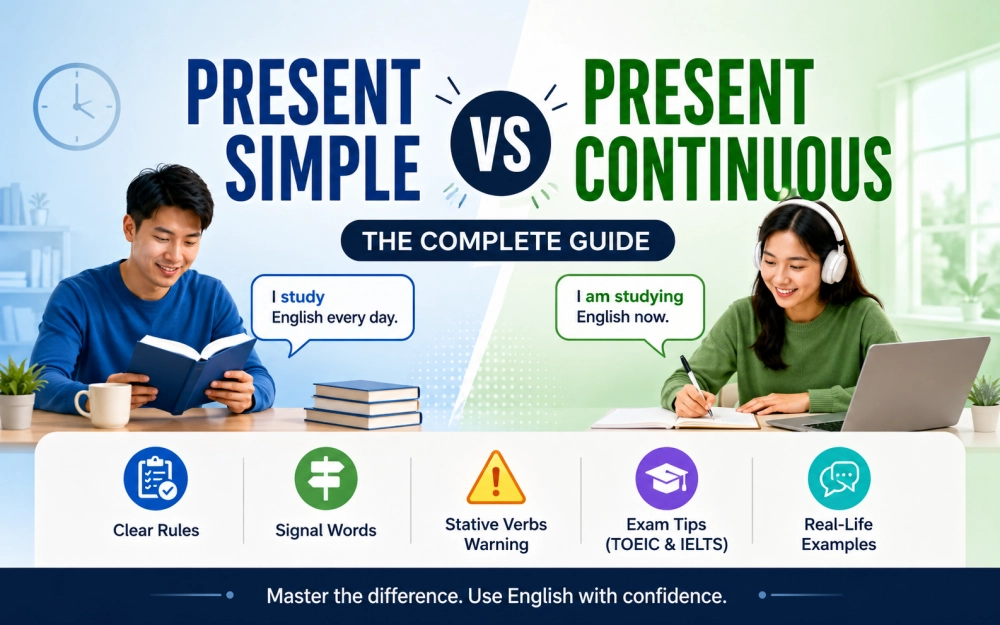
The direct answer: Present simple describes habits, permanent facts, and regular routines — She teaches English at a university. Present continuous describes actions happening right now or in a temporary period — She is teaching an online class at the moment. These two tenses are the most frequently confused pair in English grammar, and the difference between them is not just grammatical — it changes your meaning entirely.
This guide gives you every rule, every exception, and every exam trap in one place. Whether you are preparing for TOEIC, targeting an IELTS Band 7+, or simply want to sound more natural in English, understanding present simple vs present continuous is one of the highest-return grammar investments you can make.
What Is the Core Difference Between Present Simple and Present Continuous?
Present simple = the general truth, the regular pattern, the permanent state. Present continuous = what is actively in progress right now, or what is temporary.
Think of it this way: present simple takes the wide-angle view of life. Present continuous zooms in on this specific moment — or this specific, temporary phase. Consider this minimal pair:
- He drinks coffee every morning. → Present simple: a daily habit, a pattern
- He is drinking coffee right now. → Present continuous: happening at this exact second
Same person. Same activity. But the tense shifts the entire frame. That precision is what separates a confident English speaker from a hesitant one — and it is exactly what TOEIC and IELTS examiners are listening and watching for.
Present Simple — Structure, Rules, and When to Use It
How to Form Present Simple
| Structure | Form | Example |
|---|---|---|
| Affirmative (I / You / We / They) | base verb | I study English every day. |
| Affirmative (He / She / It) | base verb + -s or -es | She teaches at a language school. |
| Negative | do / does + not + base verb | He does not understand the rule. |
| Question | Do / Does + subject + base verb | Does she live in Bangkok? |
One important detail that gets overlooked: the third-person singular -s ending. It is small, easy to miss in speech, and often skipped by learners whose native languages — Vietnamese, Thai, Korean, Japanese, Mandarin Chinese — do not mark verb agreement with a suffix. In IELTS Writing, this small omission repeatedly prevents learners from reaching Band 6 in Grammatical Range and Accuracy.
5 Situations Where Present Simple Is the Right Choice
1. Habits and regular routines Anything that happens consistently, repeatedly, or on a schedule belongs in present simple. Signal words such as always, usually, often, sometimes, rarely, never, and every day / week / month are your clearest indicators.
- My students review vocabulary flashcards every morning.
- I rarely miss a practice session.
2. General facts and universal truths Scientific facts, geographical realities, and statements that are considered permanently true take present simple. These facts are not happening right now — they are just true, always.
- Water boils at 100 degrees Celsius.
- The Earth orbits the Sun once per year.
3. Permanent or long-term states When a situation has been stable for a long time and is not expected to change soon, present simple is appropriate.
- She lives in Singapore.
- He works for a global technology company.
4. Fixed schedules and official timetables This one surprises many learners at the intermediate level: we use present simple — not future tense — for confirmed, scheduled events like train departures, class times, and event programs.
- The flight departs at 6:45 AM.
- The workshop starts on Thursday.
5. Instructions, procedures, and directions Step-by-step guides, recipes, manuals, and procedural texts use present simple because each step is a general instruction, not a one-time event.
- You open the app, tap the settings icon, and select your language preference.
Present Continuous — Structure, Rules, and When to Use It
How to Form Present Continuous
| Structure | Form | Example |
|---|---|---|
| Affirmative | am / is / are + verb-ing | I am studying. She is working. They are improving. |
| Negative | am / is / are + not + verb-ing | He is not attending the session today. |
| Question | Am / Is / Are + subject + verb-ing | Are you preparing for IELTS this month? |
One common structural error — especially among Mandarin Chinese and Korean learners — is dropping the auxiliary verb entirely: She working right now instead of She is working right now. The am/is/are is not optional. It carries grammatical function.
4 Core Situations Where Present Continuous Belongs
1. Actions happening at this exact moment The most intuitive use. Something is physically or mentally in progress right now, as the words are being spoken or written.
- She is reading this article.
- I am explaining the grammar rule to you right now.
2. Temporary situations Even if the action is not happening at this precise second, present continuous is correct when the situation is temporary — it applies around this period of time.
- He is staying in London for three months.
- We are offering free placement tests this semester.
3. Developing or changing trends Present continuous captures movement and change — things that are currently shifting or growing in a particular direction.
- English is becoming the primary language of international business communication across Asia.
- More students in Vietnam are choosing IELTS over other proficiency exams for university applications abroad.
4. Confirmed future arrangements When a future event has already been planned and arranged — not just intended — present continuous is natural and correct in both spoken and written English.
- I am meeting my tutor tomorrow morning.
- They are launching the new grammar module next week.
Present Simple vs Present Continuous: The Full Side-by-Side Comparison
This is the table most learners wish they had found on day one.
| Feature | Present Simple | Present Continuous |
|---|---|---|
| Core meaning | Habits, facts, permanent states | Actions in progress, temporary phases, developing trends |
| Time frame | General / regular / always true | Right now / around now / this period |
| Key signal words | always, usually, every day, sometimes, never | now, at the moment, currently, today, this week, still |
| Stative verbs | ✅ Correct — She knows the answer. | ❌ Avoid — She is knowing is wrong. |
| Fixed timetables | ✅ Correct — The train leaves at 8. | ❌ Unusual and sounds unnatural |
| Changing trends | ❌ Less natural | ✅ Correct — Prices are rising. |
| Third-person form | Adds -s or -es — he works | Uses is + -ing — he is working |
| Temporary situations | ❌ Suggests permanence | ✅ Signals the situation is short-term |
For learners targeting TOEIC 700+ or IELTS Band 6.5+, this single table can resolve a significant number of grammar questions — because most tense errors in exams fall into one of these eight distinctions. Read this table as both a diagnostic tool and a revision checklist.
The Stative Verb Trap — The Rule That Trips Up Every Level of Learner
This is the most tested grammar point in IELTS Use of English and TOEIC Part 5. Get it wrong here and you lose marks that should have been straightforward.
Stative verbs describe a state or condition rather than an action. Because they describe something that is — not something that is being done — they do not normally work in the continuous form. You cannot watch someone knowing something, so it does not become -ing.
❌ I am knowing the answer. → Wrong. ✅ I know the answer. → Correct.
❌ She is loving this music. → Wrong. ✅ She loves this music. → Correct.
Common Stative Verbs by Category
Mental states: know, believe, understand, remember, forget, realize, mean, recognize
Emotional states: love, hate, like, dislike, prefer, want, need, fear, wish
Senses (as states): see, hear, smell, taste, feel (in their passive, non-deliberate sense)
Possession and belonging: have (possession), own, belong, contain, include, consist, exist
Appearance: seem, appear, look (as a state), sound, resemble
The important exception: Several verbs operate as both stative and dynamic, depending on meaning. Think is the classic example:
- I think this rule is clear. → stative (= I believe) → present simple ✅
- I am thinking about my next exam strategy. → dynamic (= the process of thinking) → present continuous ✅
Have works the same way:
- I have two laptops. → stative (possession) → present simple ✅
- I am having lunch. → dynamic (= experiencing) → present continuous ✅
Signal Words — Your Fastest Shortcut to Choosing the Right Tense
Signal words are time expressions and adverbs that tell you — sometimes explicitly — which tense the sentence requires. In exam conditions, scanning for signal words before selecting a verb form is one of the most reliable, time-saving strategies available.
| Signal Words → Present Simple | Signal Words → Present Continuous |
|---|---|
| always, usually, often, sometimes, rarely, never | now, right now, at the moment, at present |
| every day / week / month / year | today, this week, this month, this semester |
| on Mondays, on weekdays, on weekends | still, currently, these days, for the time being |
| in the morning, in the evenings, at night | Look! Listen! (draws attention to something happening now) |
| once a week, twice a month | temporarily, for now |
| generally, as a rule | this year (in the sense of a temporary current phase) |
Exam-specific tip: According to ETS, TOEIC is taken by more than 7 million test-takers annually across approximately 160 countries. A measurable proportion of Part 5 errors on grammar questions come from ignoring signal words that are already in the sentence. Training yourself to locate the signal word first — before analyzing the verb slot — is a strategic approach that experienced teachers consistently recommend.
How These Tenses Are Tested in TOEIC and IELTS Exams
Grammar knowledge without exam application is incomplete. Here is how present simple vs present continuous appears in each major test.
TOEIC — Part 5: Incomplete Sentences
TOEIC examiners regularly contrast these two tenses within a single test section. The structure of the trap is predictable once you know what to look for:
The regional manager ______ weekly performance reports every Friday. (A) reviews (B) is reviewing (C) reviewed (D) has reviewed
The signal word every Friday immediately points to present simple. Option B (is reviewing) is the distractor — it sounds plausible but implies the action is happening right now rather than regularly. Answer: (A) reviews.
IELTS Academic — Writing Task 1
IELTS Academic Task 1 requires you to describe data from charts, graphs, tables, or diagrams. Present simple is the dominant tense because you are reporting fixed, recorded figures.
- The bar chart shows that mobile internet usage increases sharply between 2018 and 2022.
Present continuous appears in IELTS Task 2 when you need to describe an ongoing trend or a development in progress.
- The gap between urban and rural education quality is widening in several developing economies.
IELTS Speaking — Part 1
Part 1 asks about your current life, habits, and activities. Mixing present simple (habits) and present continuous (what you are currently doing in your life) demonstrates range and earns marks for grammatical accuracy.
- I usually study for about two hours in the evening (habit → present simple), but this month I am preparing specifically for the IELTS exam, so I am spending more time on reading (temporary current phase → present continuous).
Why Learners from Specific Countries Make the Same Predictable Errors
Language transfer — the influence of your native language on English — explains the majority of tense errors made by learners worldwide. This is not a weakness; it is a predictable linguistic pattern. Recognizing your specific interference points is, in fact, one of the most effective and underused strategies for accelerating English fluency.
Vietnamese learners frequently drop the -s ending in third-person singular because Vietnamese verbs do not conjugate. Additionally, Vietnamese encodes time through context and adverbs — not through verb form — so learners may rely on signal words while leaving the verb form unchanged: She study every day instead of She studies every day.
Korean and Japanese learners work in verb-final sentence structures (Subject-Object-Verb), which creates word order instability in English. The auxiliary structure am/is/are + -ing is particularly vulnerable — these auxiliaries get dropped because the equivalent in Korean and Japanese is a single inflectional suffix on the main verb, not a separate word.
Thai learners face a similar challenge: Thai verbs are invariant. Because a time adverb already carries the tense information in Thai, the English continuous form (-ing) can feel redundant. The result is present simple used where present continuous belongs: She sleep now instead of She is sleeping now.
Chinese (Mandarin) learners often omit is/are before -ing because Mandarin does not use auxiliary linking verbs in the same positional way. They working on the project instead of They are working on the project is a consistent, predictable pattern.
Spanish-speaking learners from Mexico, Colombia, Spain, and other Spanish-speaking markets actually have a structural advantage: Spanish uses estar + gerundio as a direct equivalent of English present continuous. The challenge, however, runs in the opposite direction — Spanish speakers can over-apply the continuous form to stative verbs, producing errors like Estoy sabiendo (literally, I am knowing), which does not work in either language.
Understanding the grammar of your first language — not just the grammar of English — is the kind of innovative solution that good language teachers use to accelerate learning. EnglishPractices.com applies this localized error analysis as a core part of its grammar instruction methodology, pairing each learner's background with targeted, relevant feedback rather than generic rule recitation.
Mini Practice — Test Yourself Before Your Next Exam
Identify the correct verb form for each sentence and explain why.
- She ______ (work / is working) at a startup in Seoul this year, but she plans to return to Busan in January.
- The Amazon River ______ (flow / flows) through Brazil.
- I ______ (think / am thinking) about switching to a new study method — what do you recommend?
- We ______ (meet / are meeting) the admissions officer at 10 AM tomorrow.
- He ______ (not believe / is not believing) that the answer is correct.
Answers and Explanations:
- is working — temporary situation (this year, with a planned end date in January)
- flows — universal, permanent geographical fact
- am thinking — think used dynamically here (= the active process of considering), not as a statement of opinion
- are meeting — a confirmed future arrangement already planned
- does not believe — believe is stative; it cannot form the continuous
How EnglishPractices.com Builds Grammar Precision That Lasts
With 19 years of experience supporting learners across the UK, North America, Southeast Asia, South Korea, Japan, China, Mexico, and Singapore, EnglishPractices.com has developed a clear philosophy about grammar instruction: rules are tools, not lists to memorize. The difference between a learner who can pass a grammar quiz and one who can produce correct English under exam pressure or in a job interview comes down to understanding why each rule exists — and then practicing it in context until it becomes automatic.
The grammar curriculum at EnglishPractices.com uses a scalable architecture of instruction: each learner enters at their actual level (not their assumed level), follows a diagnostic-led pathway, and receives targeted feedback based on both English grammar patterns and their specific language background. This is not a one-size approach — it is a strategic approach built around the actual errors real learners make, not the errors that textbook writers imagine they make.
The IELTS guidance available through EnglishPractices.com, for instance, is aligned with the assessment criteria used by British Council and IDP examiners. Grammar precision — including tense consistency and appropriate tense selection — directly influences the Grammatical Range and Accuracy band score, one of the four equally weighted criteria in both Writing and Speaking. According to the British Council, IELTS is now recognized by over 11,000 organizations globally. Getting your grammar right is not a minor detail in that context.
Whether you are a student at the beginning of your English journey or a professional optimizing your performance in international communication, the full grammar learning path on EnglishPractices.com gives you a structured, mentor-guided route from confusion to confidence.
Conclusion: Every Tense Choice You Make Has a Meaning
Present simple and present continuous are not interchangeable. They carry genuinely different meanings, and the difference matters — in your exam score, in your workplace emails, in the impression you leave on a native-speaking listener or reader.
The most effective learners are not necessarily the ones who study the most grammar charts. They are the ones who understand why a rule exists, notice it in real usage around them, and apply it deliberately until it becomes instinct. That process takes time and good guidance — but it is entirely achievable at any level.
Your actionable next step: Visit EnglishPractices.com to take the free grammar diagnostic. Identify exactly which tense patterns you are getting wrong — and get a focused study plan built around those specific gaps, not a generic curriculum.
This article is produced by EnglishPractices.com — a globally recognized English learning platform with 19 years of experience supporting learners across Asia, North America, and the UK. Grammar instruction by EnglishPractices.com is built on evidence-based methodology, localized learner feedback, and exam-aligned content.