If your English sentences feel choppy, disconnected, or oddly short, there is a strong chance you are underusing conjunctions. These small linking words carry enormous grammatical weight — they join ideas, reveal the relationship between clauses, and create the natural sentence flow that separates confident English from textbook-stiff writing. Whether you are preparing for TOEIC or IELTS, improving your writing for a job in Singapore, or simply trying to sound more natural in the UK or North America, mastering conjunctions is one of the highest-return grammar investments you can make.
Direct Answer: Conjunctions are words or pairs of words that connect clauses, phrases, or individual words in a sentence. English has three main types — coordinating, subordinating, and correlative — and each serves a distinct grammatical purpose.
This guide covers all three types in depth: what they are, how they function, where learners from Thailand, Vietnam, Korea, Japan, Mexico, China, and beyond most commonly go wrong, and exactly how to apply them in both exam contexts and everyday communication.
What Are Conjunctions in English?
A conjunction connects. That is its entire job. Think of it as the grammatical glue that holds a sentence together — without it, you end up with a series of fragments rather than coherent, flowing thought.
Consider these two sentences:
She studied every night. She passed the exam.
Both are grammatically correct, but together they feel flat and abrupt. Add a conjunction and the logical relationship becomes clear:
She studied every night, so she passed the exam.
That single word "so" tells the reader the two events are causally linked. This is precisely why conjunctions matter — they communicate logic, not just information.
To see how conjunctions connect to the full picture of English grammar, the Complete English Grammar Guide at EnglishPractices.com is an excellent foundation before you go deeper into any single topic.
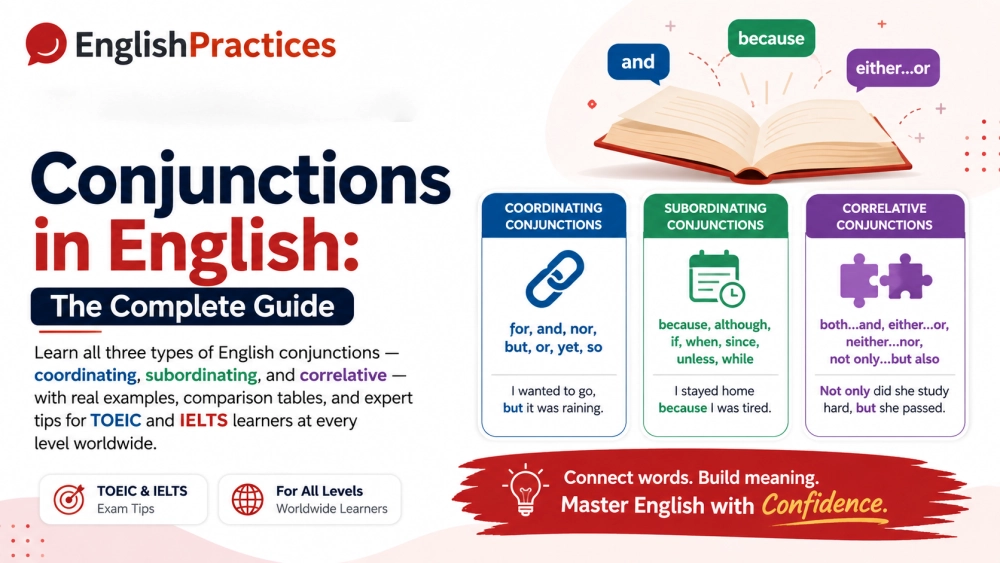
English conjunctions fall into three distinct categories:
- Coordinating Conjunctions — join grammatically equal elements
- Subordinating Conjunctions — join a dependent clause to a main clause
- Correlative Conjunctions — work in pairs to connect balanced, parallel structures
Coordinating Conjunctions: Joining Equal Ideas (FANBOYS)
What Are Coordinating Conjunctions?
Coordinating conjunctions are the most recognizable type for most learners. There are exactly seven in standard English, and the acronym FANBOYS makes them straightforward to remember:
| Conjunction | Primary Function | Example Sentence |
|---|---|---|
| For | Reason / cause | She left early, for she had a presentation. |
| And | Addition | I study English and French every morning. |
| Nor | Negative addition | He didn't call, nor did he send a message. |
| But | Contrast | The test was hard, but she finished confidently. |
| Or | Alternative / choice | You can write the report now or tomorrow. |
| Yet | Strong contrast | He was exhausted, yet he kept practising. |
| So | Result / consequence | It rained heavily, so the class was cancelled. |
How to Use Coordinating Conjunctions Correctly
The core rule is straightforward: a coordinating conjunction joins two independent clauses — meaning each side of the conjunction could stand alone as a complete sentence. When you connect two independent clauses this way, place a comma before the conjunction.
✅ She was nervous, but she delivered a confident presentation. ❌ She was nervous but delivered a confident presentation. ← No comma needed; the second part is not an independent clause.
This distinction trips up a large number of learners, particularly those whose native languages — Vietnamese, Korean, Japanese, Chinese, Thai — do not use punctuation in the same structural way. The rule is simple: two complete independent clauses together = comma + coordinating conjunction.
One more thing worth knowing: prescriptive grammar traditionally discourages beginning a formal essay sentence with a coordinating conjunction. In practice, starting with "But" or "And" for emphasis is widely accepted in modern English writing and journalism. For IELTS Task 2, however, it is safer to avoid it — examiners at IELTS are assessing academic register, and sentence-initial "And" or "So" can lower your score.
Subordinating Conjunctions: The Powerhouses of Complex Sentences
Why These Matter More Than You Think
If coordinating conjunctions connect equals, subordinating conjunctions create hierarchy. They attach a dependent clause (also called a subordinate clause) to a main clause, showing a precise logical relationship between the two. This is where genuine English sentence complexity comes from — and where IELTS Band 7+ writers truly differentiate themselves.
A dependent clause introduced by a subordinating conjunction cannot stand alone as a sentence:
❌ Because she studied every night. (Incomplete — what happened as a result?) ✅ Because she studied every night, she passed the exam.
Categories of Subordinating Conjunctions
| Category | Common Conjunctions | Example |
|---|---|---|
| Time | when, while, before, after, since, until, as soon as | Call me when you arrive. |
| Cause / Reason | because, since, as | She left because she was tired. |
| Condition | if, unless, provided that, as long as | You can go unless it rains. |
| Contrast | although, though, even though, whereas, while | Although he studied hard, he failed. |
| Purpose | so that, in order that | She spoke slowly so that everyone understood. |
| Manner | as if, as though | He spoke as if he were the manager. |
Notice how each category expresses a specific logical relationship — time, cause, contrast, condition. This precision is exactly what moves writing from "acceptable" to "advanced."
Clause Position and Comma Rules
Here is something many learners overlook: the dependent clause can appear before or after the main clause. When it comes first, use a comma to separate it. When it comes second, you generally do not need one.
Although the exam was difficult, she scored well. ← Dependent clause first: comma required. She scored well although the exam was difficult. ← Dependent clause second: no comma needed.
This flexibility gives your writing rhythm and variety — a quality that both IELTS and TOEIC examiners explicitly reward.
If you are working on conditional sentences, the conjunction "if" deserves special attention on its own. The guide to Conditionals in English at EnglishPractices.com covers all four conditional forms in detail and connects naturally to everything you are learning here about subordinating conjunctions.
Because "since," "when," and "after" are frequently used alongside perfect tenses, understanding how time subordinators work with your tense knowledge is essential. The guide to Mastering Present Perfect at EP. shows exactly how these connections play out in real sentences. Similarly, the guide to Relative Clauses: Defining vs Non-Defining at EP. is the logical next read for learners building clause-level fluency.
Correlative Conjunctions: Power in Pairs
What Makes Correlative Conjunctions Different
Correlative conjunctions always work in pairs. They connect two balanced, parallel elements in a sentence. Think of them as the grammar equivalent of a set of scales — both sides must carry equal grammatical weight.
The most common pairs in English are:
- both … and
- either … or
- neither … nor
- not only … but also
- whether … or
- as … as
- no sooner … than
The #1 Rule: Parallel Structure
The golden rule for correlative conjunctions is parallel structure. Whatever grammatical form follows the first conjunction must be mirrored in the form that follows the second.
✅ She speaks both English and French fluently. ❌ She speaks both English and is fluent in French. ← "English" is a noun; "is fluent in French" is a clause. Not parallel.
✅ Either you study consistently, or you risk falling behind. ❌ Either studying consistently or you risk falling behind. ← Gerund phrase vs. full clause. Not parallel.
Parallel structure with correlative conjunctions is tested heavily in TOEIC Part 5 (incomplete sentences) and appears regularly in IELTS Writing Task 1 and Task 2 model answers. Getting it right signals a strong command of English syntax and shows examiners you are thinking grammatically, not just writing by feel.
Verb Agreement with Correlative Conjunctions
When "either … or" and "neither … nor" connect two subjects, the verb agrees with the subject closest to it. Grammarians call this the proximity rule.
Neither the students nor the teacher was ready. ← Singular verb; "teacher" is closest. Neither the teacher nor the students were ready. ← Plural verb; "students" is closest.
This is a frequent TOEIC error trap. Always check which subject sits immediately before the verb.
All Three Types at a Glance
| Type | What It Connects | Common Examples | Basic Sentence Pattern |
|---|---|---|---|
| Coordinating | Equal clauses or elements | for, and, nor, but, or, yet, so | [Clause] , + conjunction + [Clause] |
| Subordinating | Unequal clauses (main + dependent) | because, although, when, if, since | [Sub. clause], + [Main clause] or [Main clause] + [Sub. clause] |
| Correlative | Parallel paired structures | both…and, either…or, neither…nor | [First element] + … + [Matching element] |
Common Conjunction Mistakes — and How to Fix Them
1. The Comma Splice: Using a Comma Without a Conjunction
This is among the most widespread errors in written English across every nationality:
❌ She was tired, she continued studying. ✅ She was tired, but she continued studying. ✅ She was tired; however, she continued studying.
A comma alone cannot join two independent clauses. You need a coordinating conjunction, or a semicolon followed by a conjunctive adverb such as "however," "therefore," or "consequently."
2. Confusing "Although" with "Despite"
❌ Although, she studied hard, she failed. ✅ Although she studied hard, she failed. ✅ Despite studying hard, she failed.
"Although" is a subordinating conjunction — it introduces a clause with its own subject and verb. "Despite" is a preposition — it is followed by a noun or gerund. They are not interchangeable, and mixing them up is an extremely frequent error in IELTS Writing Task 2.
Understanding the contrast between conjunctions and prepositions becomes clearer when you study both in context. The guide to Prepositions of Time, Place, and Movement at EP. offers a useful structural contrast that reinforces what you are learning here.
3. Forgetting Parallel Structure in Correlative Pairs
After writing a sentence with "both … and" or "either … or," stop and check: does the grammatical form mirror itself on both sides? If you have a noun after the first element, you need a noun after the second. If you have a verb phrase, you need a matching verb phrase.
4. Misreading "Since" as Only a Time Word
"Since" functions as both a time subordinator and a cause subordinator, and the distinction matters:
Since 2020, she has studied English online. ← Time Since she was late, she missed the introduction. ← Cause / reason
Context usually makes the meaning clear, but in TOEIC Reading Comprehension, both uses appear in the same passage. Read the whole sentence before assigning meaning.
For learners working through tense behaviour around time conjunctions — particularly "since," "after," and "before" — the guide to Past Simple vs Past Perfect and the guide to Present Simple vs Present Continuous at EnglishPractices.com give the tense-level clarity these words demand.
Conjunctions in TOEIC and IELTS: What Examiners Look For
TOEIC Part 5 and Part 6
TOEIC tests conjunctions directly in Part 5 (incomplete sentences) and Part 6 (text completion). The most commonly tested areas are:
- Choosing between coordinating and subordinating conjunctions based on logical meaning ("because" vs. "although" vs. "so")
- Recognizing complete correlative pairs, particularly "either … or" and "neither … nor"
- Identifying correct parallel structure in complex sentences
The key strategy: read the entire sentence before selecting an answer. The logical relationship between the two clauses tells you which conjunction category — and which specific word — fits.
IELTS Writing Bands 7–9
The official IELTS Public Band Descriptors (published by the British Council, IDP, and Cambridge Assessment English) explicitly reward cohesion and coherence at Band 7 and above. The Band 7 descriptor requires "a range of cohesive devices" and "flexible use of reference and substitution" — both of which depend directly on accurate, varied conjunction use.
In practice, this means:
- Do not lean solely on "and," "but," and "because." These mark a Band 5–6 range.
- Use subordinating conjunctions to write complex sentences: although, whereas, given that, provided that.
- Deploy correlative conjunctions for balanced, sophisticated structures that show grammatical awareness.
A response that only uses coordinating conjunctions will read as simple, regardless of vocabulary level. The interplay between conjunction types creates the grammatical range examiners reward at higher bands — and EP. content is built with exactly that progression in mind.
The EnglishPractices.com Approach to Conjunction Mastery
At EP., grammar is never taught in isolation. The team at EnglishPractices.com — with over 19 years of experience supporting learners across the UK, North America, Thailand, Vietnam, Korea, Japan, Singapore, Mexico, China, and globally — understands that conjunctions only truly stick when practiced in authentic communicative contexts, not memorized in abstract lists.
That is why grammar content at EP. is structured as an interconnected system. Conjunctions link directly to reported speech (where "that," "if," and "whether" function as subordinating conjunctions shifting direct speech into indirect). They connect to gerunds and infinitives, because the verb form following a conjunction depends on the clause it introduces. They connect to conditionals, where "if" and "unless" drive the entire sentence logic. Rather than treating each topic as a standalone lesson, EP. builds grammar understanding cumulatively — the way real language acquisition works.
For learners building a solid foundation, the guide to Gerunds vs Infinitives at EP. is a natural companion to this article — because the choice between a gerund and an infinitive after a conjunction is a frequent source of errors at intermediate level. And the guide to Reported Speech Rules at EP. shows how "that," "if," and "whether" shift between direct and indirect speech, which is another key conjunction skill tested in both TOEIC and IELTS.
Conclusion: Small Words, Big Results
Conjunctions are short — many are just two or three letters long. But they carry the entire logical architecture of a sentence. They show cause, contrast, time, condition, and balance. Getting them right does not just eliminate grammar errors; it transforms how clearly and confidently you communicate in English.
The practical steps forward are clear:
- Memorize FANBOYS and write compound sentences every day until the comma placement becomes automatic.
- Learn the subordinating conjunction categories — time, cause, contrast, condition, purpose — and use at least one in every writing task you complete.
- Practice correlative pairs in your speaking and writing until parallel structure becomes instinctive rather than something you have to think about.
- Review your writing after drafting, looking specifically for comma splices and structural mismatches inside correlative pairs.
If you want structured, expert-guided practice covering conjunctions alongside every other core grammar area, explore the full grammar library at EnglishPractices.com. Whether you are working toward a TOEIC score target, improving your IELTS writing band, or building everyday English confidence for life in an English-speaking environment, EP. has a clear, well-sequenced path for you.
Ready to practise? Explore the full grammar learning path on EnglishPractices.com and test your conjunction skills with the interactive quiz below.