Picture this: you are writing an IELTS Writing Task 2 response, a business email to a partner in London, or a university admission essay for a program in Singapore. You type — confidently — "I have received many informations from the research." The grammar checker flags it. You stare at the screen and wonder what exactly went wrong.
The answer is one of the most fundamental distinctions in English grammar: countable and uncountable nouns. This single classification determines which articles you use, which quantifiers you can choose, and whether your sentence sounds natural to a native speaker or immediately signals an error to an IELTS examiner or a TOEIC grader.
The impact is real. Errors with uncountable nouns — "advices," "an information," "furnitures," "much people" — appear consistently across learner submissions from Vietnam, Korea, Japan, Thailand, Mexico, and China, precisely because many of these languages do not mark plurality the same way English does. The rules feel arbitrary until you understand the underlying logic.
This guide gives you everything: clear definitions, formation rules, a complete quantifier reference, the most commonly confused dual-use nouns, partitive expressions, TOEIC and IELTS exam strategies, and hands-on exercises. By the end, you will not just know the rules — you will understand why they exist
What Are Countable and Uncountable Nouns? (Direct Answer)
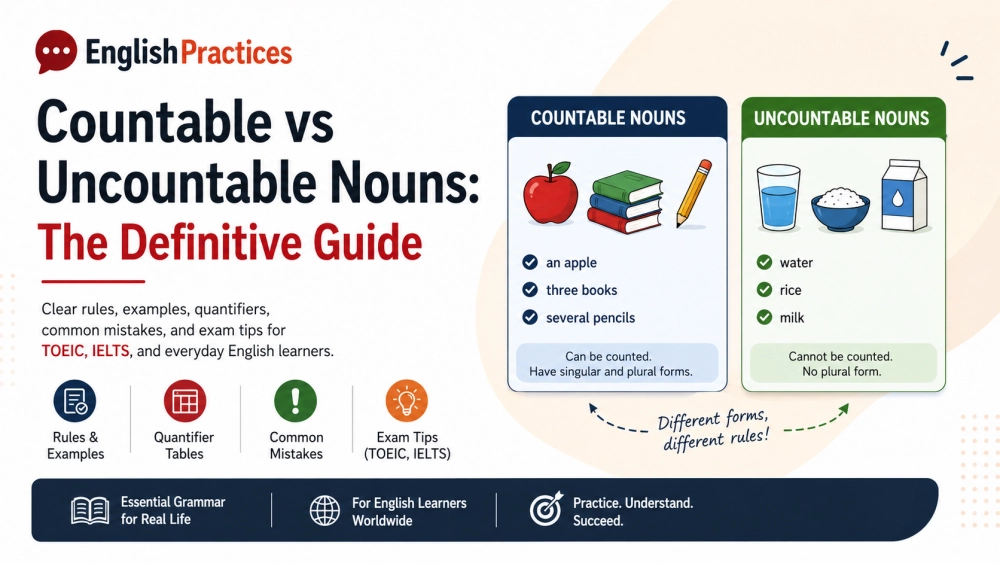
Countable nouns are nouns that can be counted individually. They have both a singular and a plural form, and you can use "a" or "an" before the singular.
· Singular: a book, an idea, a question
· Plural: books, ideas, questions
Uncountable nouns (also called mass nouns) refer to things that cannot be divided into individual, countable units. They have no standard plural form and cannot take "a" or "an."
· Examples: water, information, advice, furniture, music, progress
The diagnostic question: Can you say "one _____, two _____s"? If yes → countable. If no → uncountable.
Countable Nouns: Rules, Forms, and Examples
Countable nouns are exactly what they sound like — things you can physically separate and count. A book on a shelf. A question on an exam. A decision in a meeting. A student in a classroom.
The grammar rules for countable nouns are consistent and predictable:
- Singular form takes "a" or "an": a chair, an umbrella, a question, an engineer
- Plural form follows regular or irregular patterns**: chairs, umbrellas, questions, engineers, children, teeth, mice*
- Numbers attach directly: one chair, three questions, twelve engineers
- Countable-specific quantifiers apply: many, a few, several, each, every
Most concrete, physical objects are countable — a car, a document, a computer, a strategy. Abstract nouns can also be countable when they refer to distinct, separate instances: an idea, a decision, a problem, a challenge, an experience. The key is whether the concept has discrete, separable units. When it does, the noun is countable.
Uncountable Nouns: Five Categories You Need to Know
Uncountable nouns are where consistent errors begin — and where understanding the categories makes the logic far clearer. These nouns refer to things that are either measured in bulk, experienced as an abstract whole, or treated collectively as a single unit.
Category 1: Liquids and substances Water, milk, oil, air, salt, sugar, rice, sand, blood, petrol
Category 2: Abstract concepts and qualities Advice, information, knowledge, research, evidence, happiness, intelligence, freedom, courage
Category 3: Academic subjects and activities Homework, work, travel, music, sport (British English), education, training, progress
Category 4: Groups treated as a single whole Furniture, luggage, equipment, clothing, traffic, machinery, staff (in collective sense)
Category 5: Natural materials and phenomena Weather, electricity, wood, glass, metal, paper (the material), plastic
The critical rule across all five categories: no "a/an," no plural -s, no direct number.
- ❌ "She gave me an advice." → ✅ "She gave me advice."
- ❌ "We need more furnitures." → ✅ "We need more furniture."
- ❌ "The informations are incorrect." → ✅ "The information is incorrect."
Countable vs. Uncountable: Key Differences at a Glance
| Feature | Countable Nouns | Uncountable Nouns |
|---|---|---|
| Can be counted directly | ✅ one book, two books | ❌ not "one water, two waters" |
| Has a plural form | ✅ books, ideas, chairs | ❌ no "informations," "advices" |
| Uses "a" or "an" | ✅ a book, an idea | ❌ not "an advice," "a furniture" |
| Uses "the" | ✅ the book, the questions | ✅ the water, the information |
| Uses "many" / "few" | ✅ many books, few students | ❌ |
| Uses "much" / "little" | ❌ | ✅ much water, little time |
| Verb agreement | Singular or plural | Always singular |
This table is worth returning to. A large portion of TOEIC Part 5 and IELTS Writing errors trace directly to applying countable rules to uncountable nouns — or the reverse. Getting this chart into your instincts is the fastest path to eliminating a whole class of errors.
Articles with Countable and Uncountable Nouns: The Core Rules
Articles — "a," "an," and "the" — behave differently depending on whether a noun is countable or uncountable. This is one of the most tested grammar areas in both TOEIC and IELTS, and it also one of the most practically important for professional communication.
"A" and "an" — use only with singular countable nouns:
- a decision ✅ | an opportunity ✅ | a water ❌ | an information ❌
"The" — use with both countable and uncountable nouns when the noun is specific and mutually understood:
- The meeting was productive. (specific, singular countable)
- The water in this glass is cold. (specific, uncountable)
- The decisions made yesterday were final. (specific, plural countable)
No article — use with uncountable nouns in general reference and plural countable nouns in general reference:
- Water is essential for life. (uncountable, general)
- Books are expensive. (plural countable, general)
- Information travels fast in the digital age. (uncountable, general)
This relationship between general and specific reference is also central to how present tenses work. The EP. guide on Present Simple vs Present Continuous explores how general vs. specific meaning shifts between tenses — a pattern that maps directly onto article choice with both countable and uncountable nouns.
Quantifiers: Which Words Work with Which Nouns?
Quantifiers express amount or quantity, and choosing the wrong one is one of the most consistent error types in learner English. The reason is simple: certain quantifiers are exclusively for countable nouns, others are exclusively for uncountable nouns, and a third group works for both.
| Quantifier | Countable Nouns | Uncountable Nouns |
|---|---|---|
| many / a few / few | ✅ (many ideas, a few candidates) | ❌ |
| much / a little / little | ❌ | ✅ (much effort, a little patience) |
| some / any | ✅ (some questions, any concerns) | ✅ (some advice, any information) |
| a lot of / lots of | ✅ (a lot of options) | ✅ (a lot of evidence) |
| several | ✅ (several attempts) | ❌ |
| each / every | ✅ (each question, every student) | ❌ |
| enough | ✅ (enough chairs) | ✅ (enough time) |
| no | ✅ (no problems) | ✅ (no evidence) |
Quick memory rule: "many" and "few" are for things you count. "Much" and "little" are for things you measure. When in doubt, "a lot of" and "some" work safely with both — they are the universal options.
These quantifiers also intersect frequently with perfect aspect structures. "We haven't made much progress" (uncountable) and "We've submitted a lot of reports" (countable) are patterns that appear consistently in IELTS Writing and TOEIC reading passages. The EP. resource on Present Perfect Tense explains how quantifiers and perfect aspect work together — a combination that is high-frequency in both exams.
Nouns That Can Be Both Countable and Uncountable
Here is where many learners hit a wall — and where understanding context becomes more important than memorizing lists. A significant number of English nouns shift between countable and uncountable depending on what they mean in a specific sentence.
| Noun | As Uncountable | As Countable |
|---|---|---|
| coffee | I love coffee. (the substance) | Can I have two coffees? (servings) |
| paper | Print it on paper. (the material) | She published a paper on AI. (a document) |
| experience | She has great experience. (general quality) | Moving abroad was a great experience. (specific event) |
| glass | The table is made of glass. (material) | She drank from a glass. (a container) |
| time | Time passes quickly. (abstract concept) | This is my third time in Tokyo. (an occasion) |
| work | I have a lot of work today. (tasks/effort) | The gallery displayed great works of art. (pieces) |
| light | The room needs more light. (illumination) | Turn off the lights. (lamps or switches) |
| iron | The gate is made of iron. (metal) | She used an iron to press her shirt. (appliance) |
In each case, the context — not the word alone — determines the classification. When "coffee" means the beverage in general, it is uncountable. When it means a specific serving, it is countable and can be pluralized. Developing the instinct to read context rather than memorize word-by-word is a high-value skill for any learner, at any level.
This context-sensitivity also appears in conditional structures. For example: "If there were enough evidence, the case would be stronger" — where "evidence" is uncountable and takes a singular conditional verb. The EP. resource on Conditionals in English shows how noun type affects verb form and structure inside hypothetical and real conditional sentences.
Partitive Expressions: How to Quantify Uncountable Nouns
Since numbers cannot attach directly to uncountable nouns, English uses partitive expressions — also called measure phrases — to specify amounts. These follow the pattern: a [unit] of [uncountable noun].
Common partitive expressions across five contexts:
Information and abstract nouns:
- a piece of advice / information / evidence / news / research
Food and drink:
- a glass of water / juice / milk
- a cup of coffee / tea / soup
- a loaf of bread
- a slice of pizza / cheese / cake
Materials and objects:
- a sheet of paper
- a block of wood / ice
- a lump of sugar / coal
Informal quantities:
- a bit of help / luck / fun / trouble
- a great deal of experience / effort / patience
Items and units:
- an item of clothing / luggage / news
Notice the pattern: the uncountable noun itself never changes — only the measure word takes a plural when needed. "Three pieces of advice" is correct; "three advices" is not. In IELTS Writing Task 1, these expressions are essential for describing quantities and proportions without grammatical errors, because the source data frequently involves uncountable nouns (traffic, rainfall, information, equipment).
Common Mistakes with Countable and Uncountable Nouns
These six errors appear consistently across thousands of learner submissions reviewed at EP., particularly among students whose first languages — including Thai, Vietnamese, Korean, Mandarin Chinese, and Japanese — do not grammatically mark plurality the same way English does. Awareness is the first step; correction is the practice.
Mistake 1: Adding -s to uncountable nouns
- ❌ "She gave me three advices."
- ✅ "She gave me three pieces of advice."
Mistake 2: Using "a/an" before uncountable nouns
- ❌ "Could you give me an information about the schedule?"
- ✅ "Could you give me some information about the schedule?"
Mistake 3: Using "many" with uncountable nouns
- ❌ "We don't have many time."
- ✅ "We don't have much time."
Mistake 4: Using "much" with countable nouns
- ❌ "There are much students in the class."
- ✅ "There are many students in the class."
Mistake 5: Treating "news" as plural (because of the -s ending)
- ❌ "The news are shocking."
- ✅ "The news is shocking." (news = uncountable → singular verb)
Mistake 6: Pluralizing group/material nouns
- ❌ "We bought new furnitures and equipments for the office."
- ✅ "We bought new furniture and equipment for the office."
Seeing these errors in the broader context of grammar — where article choice, verb agreement, and quantifier selection all intersect — makes the corrections stick better than isolated drilling. The Complete English Grammar Guide at EP. positions these rules within a complete grammatical framework, which helps learners build connected understanding rather than fragmented lists of exceptions.
Countable and Uncountable Nouns in TOEIC and IELTS: What Examiners Look For
Both exams test this area heavily and in specific, predictable patterns. Knowing what each exam focuses on allows you to prepare more efficiently.
TOEIC Strategy
In TOEIC Parts 5 and 6, article and quantifier errors are among the most frequently appearing grammar traps. A typical TOEIC-style question:
"The company provided _______ equipment for the new department." A) a B) many C) several D) some
The correct answer is D — some. "Equipment" is uncountable, so "a" (article for singular countable), "many" (countable quantifier), and "several" (countable quantifier) are all grammatically impossible. Only "some" — which works with uncountable nouns — fits correctly. This single question tests whether you know the noun classification, not just the grammar rule.
IELTS Strategy
In IELTS Writing Task 2, certain high-frequency academic nouns are almost always uncountable: research, evidence, information, knowledge, progress, advice, feedback. Using them as countable nouns — "researches show," "many evidences," "informations suggest" — signals a grammatical error that directly affects the Grammatical Range and Accuracy criterion.
According to the public IELTS band descriptors published by Cambridge Assessment English, Band 7 requires frequent use of complex structures with few grammatical errors. Consistent misclassification of uncountable nouns places a ceiling on your band score in Writing, regardless of how well you argue your ideas.
The EP. guide on Mastering Present Perfect shows how noun classification connects to tense and aspect choices in high-band IELTS writing — a combination that rewards learners who understand grammar as an integrated system rather than isolated rules.
Countable and Uncountable Nouns in 2026: A Persistent Challenge That AI Cannot Fully Solve
Despite the rapid growth of AI writing tools and grammar-checking software in classrooms from Bangkok to São Paulo, incorrect noun classification remains one of the most persistent error types in learner English as of 2026. Tools can flag "advices" or "an information." What they cannot reliably do is determine whether "experience" in a given sentence is countable or uncountable — because that requires reading meaning, not matching patterns.
For learners in IELTS, TOEIC, academic writing programs, and professional English environments across the UK, North America, Singapore, and South Korea, developing a real instinct for this distinction is what separates test-ready learners from truly fluent ones. The goal is not to memorize a list — it is to internalize the logic that makes the list unnecessary.
Countable and Uncountable Nouns Exercises: Practice Now
Exercise 1 — Countable or Uncountable?
Label each noun as C (countable) or U (uncountable).
- homework
- suggestion
- luggage
- chair
- progress
- report
- music
- factory
- traffic
- announcement
Exercise 2 — Choose the Correct Quantifier
Fill in the blank with the correct quantifier from the options in brackets.
- We don't have _______ (much / many) time before the deadline.
- She made _______ (a few / a little) helpful suggestions before the meeting.
- There is _______ (much / many) evidence supporting this theory.
- _______ (Several / Much) candidates applied for the position this year.
- Could you give me _______ (a few / a little) advice on improving my presentation?
Exercise 3 — Correct the Error
Each sentence contains one error. Find it and fix it.
- "The team needs new equipments for the laboratory."
- "Can you give me an advice on how to improve my writing?"
- "There are much people waiting outside the venue."
- "The informations you provided are very useful."
- "She has many experiences in project management."
✅ Answer Key
Exercise 1:
- U 2. C 3. U 4. C 5. U 6. C 7. U 8. C 9. U 10. C
Exercise 2:
- much 2. a few 3. much 4. Several 5. a little
Exercise 3:
- "The team needs new equipment for the laboratory." — No plural form for uncountable nouns.
- "Can you give me some advice on how to improve my writing?" — "An" cannot precede uncountable nouns; use "some."
- "There are many people waiting outside the venue." — "People" is countable; use "many," not "much."
- "The information you provided is very useful." — "Information" is uncountable: no plural form, singular verb.
- "She has a lot of experience in project management." — In this context, "experience" is uncountable (general quality). If referring to specific events, "experiences" is possible but changes the meaning.
Conclusion: One Classification, Dozens of Grammar Decisions
Countable and uncountable nouns are not an obscure grammar rule tucked away in the back of a textbook. Every article choice, every quantifier selection, every verb agreement decision starts with a single, silent question: is this noun countable or uncountable? Get that right — consistently, instinctively — and a whole class of grammar errors disappears.
The categories, the quantifier table, the dual-use nouns, the partitive expressions, and the exercise corrections in this guide are all tools you now have. The next step is using them in real writing: drafting emails, practicing IELTS essays, completing TOEIC grammar drills, and coming back to this guide when an unfamiliar noun trips you up.
EnglishPractices.com has supported English learners across the UK, North America, Southeast Asia, East Asia, and Latin America for over 19 years. Every resource at EP. is built on one principle: deep understanding always outperforms shallow memorization — in exams and in life.
Ready to go further? Explore the full grammar library at EnglishPractices.com and find the resource that matches where you are right now and where you want to be.