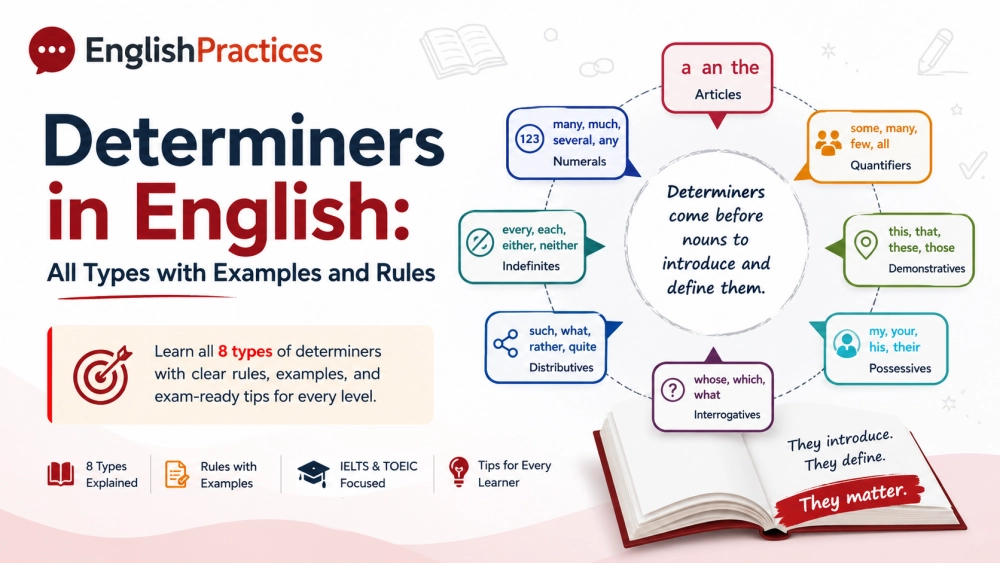
If you have ever written "I need a advice" and immediately felt something was off, you were already sensing the logic of determiners—even without knowing the term. These small words sit before nouns and do surprisingly heavy lifting: they tell your reader which noun you mean, how many exist, and whose it belongs to. Miss them, and even a well-constructed sentence can sound unnatural. Use them with precision, and your English immediately signals fluency.
Determiners in English are words placed directly before a noun to identify, quantify, or specify it. They include articles (a, an, the), possessives (my, your, their), demonstratives (this, those), quantifiers (some, many, much), and four other categories—eight types in total.
This guide covers all eight, with clear definitions, examples, rules, and exam-specific tips for IELTS and TOEIC candidates. Whether you are a university student in Korea, a business professional in Vietnam, a TOEIC candidate in Mexico, or an advanced learner preparing for a Cambridge exam in the UK—the same rules apply. Determiners are universal in English, and mastering them is one of the most reliable markers of grammatical accuracy in both writing and speech.
What Are Determiners in English?
⚡ Quick Answer A determiner is a word placed before a noun—or noun phrase—to specify which noun is meant, how many there are, or whose it is. Every noun phrase in English typically begins with a determiner. Examples: the book, my phone, some water, each student, those files, three reports. English has eight main types.
Unlike adjectives, which describe a noun, determiners define or limit it. The distinction matters in practice:
| Feature | Determiner | Adjective |
|---|---|---|
| Function | Limits or identifies the noun | Describes or modifies the noun |
| Example | the book, some water | interesting book, cold water |
| Position in noun phrase | Always first | After the determiner |
Determiners belong to a closed class—English has a fixed, finite set of them. This contrasts with adjectives, which are practically unlimited. Because the set is closed, learning all determiner types is completely achievable. No surprises lurk beyond the eight categories below.
Why Determiners Matter More Than You Think
Here is an uncomfortable truth: determiner errors are among the most persistent and noticeable grammar mistakes in English—especially for learners whose native languages handle nouns differently.
In Thai, Vietnamese, Korean, Chinese, and Japanese, there is no direct equivalent to a or the. This structural gap is the primary reason learners from these regions tend to either omit articles entirely (I have dog) or overstuff them (I gave the advice to the my friend). The patterns are predictable—and entirely fixable once you understand the system behind the choices.
For IELTS candidates, the stakes are measurable. According to the British Council's published IELTS Writing Band Descriptors, candidates at Band 7 demonstrate "a variety of complex structures with some flexibility and accuracy." Persistent determiner errors— such as using much with countable nouns or omitting the before unique nouns—are characteristic of Band 5 performance, where "errors in grammar and punctuation occur but rarely impede communication." One level. Real difference.
For everyday fluency in the UK, North America, and Singapore, where English is the professional standard, determiner precision marks the line between a speaker who sounds translated and one who sounds natural.
Understanding determiners also becomes much clearer when paired with solid knowledge of countable vs. uncountable nouns—because whether a noun is countable or uncountable directly governs which determiners you can legally use with it.
The 8 Types of Determiners in English
1. Articles: A, An, The
Articles are the most frequently used determiners in English. The Cambridge English Corpus consistently shows the among the ten most common words in written English. Yet for all their frequency, articles cause more errors than any other determiner type. There are only three of them, but the rules beneath each one are layered.
Indefinite Articles: A / An
Use a before words beginning with a consonant sound, and an before words beginning with a vowel sound. The critical point: it is the sound that governs the choice, not the spelling.
-
a university → starts with the /juː/ sound (consonant)
-
an hour → starts with the /aʊ/ sound (vowel; the h is silent)
-
an honest person, a European, a one-way street
Use indefinite articles when introducing a noun for the first time, or when referring to any one member of a general category:
She adopted a cat last month. The cat follows her everywhere. (First mention → a; second mention → the)
Definite Article: The
Use the when both speaker and listener already know which specific noun is meant, for unique entities, and with superlatives:
-
the president, the sun, the Eiffel Tower
-
Did you lock the door? (Both people know which door.)
-
She won the highest award in the competition.
Zero Article — No Article at All
With plural countable nouns and uncountable nouns used in general statements, English uses no article:
Books change lives. Water is essential. Dogs make loyal companions.
For a comprehensive breakdown of every article rule—including zero-article contexts, idiomatic exceptions, and geographic names—the complete guide to articles in English on EP covers each case with precision.
2. Demonstrative Determiners: This, That, These, Those
Demonstrative determiners point to specific nouns and signal their proximity—physical or conceptual—relative to the speaker.
| Determiner | Noun Type | Distance from Speaker |
|---|---|---|
| this | singular | near |
| that | singular | far |
| these | plural | near |
| those | plural | far |
This laptop on my desk is new. That building across the street was built last year. These reports are ready to submit. Those files from 2022 are already archived.
The determiner and noun must always agree in number. This books and these book are both incorrect. Singular nouns take this/that; plural nouns take these/those—no exceptions.
3. Possessive Determiners: My, Your, His, Her, Its, Our, Their
Possessive determiners show ownership or association and always precede a noun. This distinguishes them from possessive pronouns (mine, yours, his, hers, ours, theirs), which stand alone without a following noun.
| Person | Singular | Plural |
|---|---|---|
| 1st | my | our |
| 2nd | your | your |
| 3rd | his / her / its | their |
She submitted her assignment on time. The organisation updated its annual report.
The single most common possessive error: confusing its (possessive determiner) with it's (contraction for it is or it has). This distinction appears in TOEIC Part 5 with notable regularity.
✅ The system completed its final update. ❌ The system completed it's final update.
One is a determiner. The other is two words compressed into one. They are never interchangeable.
4. Quantifiers: Some, Any, Many, Much, Few, Little, Several, Enough
Quantifiers express amount or degree, and most of them are restricted by noun type. Getting this wrong is the source of some of the most persistent grammar errors across all English proficiency levels globally.
| Quantifier | Use With | Example |
|---|---|---|
| many / few / several / a number of | countable nouns only | many students, few ideas, several reports |
| much / little / a great deal of | uncountable nouns only | much time, little water, a great deal of effort |
| some / any / enough / a lot of / plenty of | both countable and uncountable | some advice, some questions, enough time |
The some vs. any rule adds another layer: use some in affirmative sentences and polite offers; use any in questions and negatives. There is one important exception to know:
Would you like some coffee? ← an offer, so some (not any) I do not have any experience in this area. Are there any seats available?
Also worth knowing: few and a few carry opposite nuances—and so do little and a little:
-
I have few options → barely any (negative nuance)
-
I have a few options → some, a small but real number (positive nuance)
-
There is little hope → almost none
-
There is a little hope → some remains
The article a changes the meaning entirely. This distinction is tested directly in IELTS Writing Task 2 and TOEIC reading sections.
5. Numerals as Determiners
Cardinal numerals (one, two, three…) and ordinal numerals (first, second, third…) function as determiners when they precede a noun directly. They quantify or sequence the noun without requiring any additional article.
She submitted three proposals. The second proposal won the contract.
In IELTS Academic Writing Task 1, ordinal numerals are indispensable for data description: the first quarter, the second highest figure, the third decade. The article the must appear before ordinals in formal contexts—a detail that separates Band 6 from Band 7 responses.
6. Distributive Determiners: Each, Every, Either, Neither
Distributive determiners refer to members of a group individually or in contrasting pairs. They are frequently tested in grammar exams precisely because their rules are specific and non-negotiable.
-
Each focuses on individual members one at a time: Each student received individual feedback.
-
Every emphasises the group as a complete, unified set: Every student passed the final exam.
-
Either = one or the other of two: You can take either road to the venue.
-
Neither = not one and not the other: Neither option meets our requirements.
The singular rule—and it is absolute: all four distributive determiners take a singular noun and trigger singular verb agreement.
✅ Every candidate has submitted a completed form. ❌ Every candidates have submitted forms.
This is one of the most consistently tested points across TOEIC Part 5 and IELTS Writing Task 2 grammatical accuracy criteria.
7. Interrogative Determiners: Which, What, Whose
Interrogative determiners introduce questions and always modify a noun directly. This is what distinguishes them from interrogative pronouns, which stand alone.
Which course do you recommend? (determiner modifying course) What time does the seminar begin? Whose report is still missing from the folder?
The which vs. what distinction is subtle but worth knowing:
-
Use which when the choice is limited: Which session are you attending—morning or afternoon?
-
Use what when the choice is open-ended: What subject did you study at university?
This distinction comes up in polite professional conversation and formal written English alike.
8. Exclamative Determiners: What, Such
Exclamative determiners appear in exclamatory sentences and express strong feeling or emphasis. They are the least tested type in formal exams but appear regularly in written and spoken English.
-
What precedes a singular countable noun (with a/an) or a plural/uncountable noun without an article:
-
What a brilliant performance!
-
What courage that decision required!
-
-
Such precedes a noun phrase, often with an adjective:
-
Such dedication deserves recognition.
-
Such a clear explanation made everything easier.
-
Determiner Placement Rules You Need to Know
Within any noun phrase, determiners follow a strict sequence. Violating this order produces ungrammatical sentences—even when every individual word is correct.
The order: Pre-determiner → Central Determiner → Post-determiner → (Adjective) → Noun
-
Pre-determiners: all, both, half, double, such, what (exclamations)
-
Central determiners: articles, demonstratives, possessives, interrogatives — only one central determiner per noun phrase
-
Post-determiners: numerals, quantifiers (three, many, several, few)
All the students passed. (pre-determiner + central + noun) All my three children attended. (pre-determiner + possessive + numeral + noun) Both those problems need attention. (pre-determiner + demonstrative + noun)
Two central determiners can never stack together. The my car and a this book are always wrong—no exceptions, no context where they become acceptable.
Understanding how determiners work within noun phrases also clarifies how prepositions of time, place, and movement attach to those noun phrases in complete sentences—because both systems position meaning around the noun at the heart of your clause.
Common Determiner Confusion: Quick Reference Table
| Confusion Pair | The Rule | Correct Example |
|---|---|---|
| a vs. an | Based on sound (not spelling) of the next word | an hour / a university |
| much vs. many | Uncountable vs. countable noun | much traffic / many cars |
| few vs. a few | Negative nuance vs. positive nuance | few friends (barely any) / a few friends (some) |
| little vs. a little | Same distinction for uncountable nouns | little time (almost none) / a little time (some remains) |
| each vs. every | Individual focus vs. collective totality | each student / every student |
| some vs. any | Affirmatives + offers vs. questions + negatives | some tea? / not any sugar |
| which vs. what | Limited choice vs. open-ended choice | which floor? / what reason? |
| its vs. it's | Possessive determiner vs. contraction | its design / it's raining |
Determiners in IELTS and TOEIC: What Examiners Actually Check
Both exams test determiner accuracy directly, and the evidence from official scoring criteria makes this clear.
In IELTS Writing, the British Council's published Band Descriptors specify that Band 7 candidates demonstrate "a variety of complex structures with some flexibility and accuracy." Consistent determiner errors push responses toward Band 5, where errors occur but "rarely impede communication." For Band 7 and above, determiner use must be reliably accurate across the response—not just occasionally correct.
In TOEIC Part 5 (incomplete sentences) and Part 6 (text completion), determiner choices appear in every test form: selecting between a/an/the, choosing some vs. any, picking each vs. every, and completing quantifier phrases. These are not obscure grammar points—they are the same decisions you make daily in professional writing.
Quick exam checklist before your next test:
-
First mention of a noun → a or an
-
Known or specific noun → the
-
General statement with plural or uncountable noun → zero article
-
Uncountable noun + quantity → much, little, a little, a great deal of
-
Countable noun + quantity → many, few, a few, several
-
Singular noun after every/each/either/neither → singular verb
For a structured approach to IELTS and TOEIC preparation across all grammar topics, the complete English grammar guide on EP covers determiners within the full grammar system—not as an isolated topic, but as one connected piece of accurate English.
Common Determiner Mistakes and How to Fix Them
These five errors appear across all proficiency levels—in professional emails in Singapore, university essays in the UK, TOEIC answer sheets in Japan, and IELTS scripts in Mexico. They are persistent precisely because they feel small. They are not.
Mistake 1: A before a vowel sound
❌ It was a honest mistake. ✅ It was an honest mistake. (h is silent; the first sound is the vowel /ɒ/)
Mistake 2: Many with uncountable nouns
❌ She gave me many useful information. ✅ She gave me a lot of useful information. (information is uncountable)
Mistake 3: Omitting the before unique or mutually understood nouns
❌ Sun rises in east. ✅ The sun rises in the east.
Mistake 4: Every with a plural noun and plural verb
❌ Every students must register by Friday. ✅ Every student must register by Friday.
Mistake 5: Mixing up its and it's
❌ The programme completed it's final phase. ✅ The programme completed its final phase.
Determiner accuracy connects to broader sentence-level grammar as well. Knowing how to use conjunctions in English well means you can combine noun phrases naturally—and the determiners in both clauses still need to agree with their respective nouns. Similarly, understanding how modal verbs frame noun phrases in hypothetical or tentative statements helps you place determiners with far greater confidence in both formal and informal registers.
How EnglishPractices.com Approaches Determiner Mastery
At EP, grammar is never taught in isolation. With over 19 years of experience helping learners from the UK, North America, Thailand, Vietnam, Korea, Mexico, China, Japan, Singapore, and beyond, the team at EnglishPractices.com has seen the same pattern repeat across markets: grammatical errors in professional and academic English almost always trace back to foundational word-class gaps—and determiners rank consistently in the top three.
The approach at EnglishPractices.com is to build a connected system, not a list of rules to memorise and forget. Determiners interact with noun types, article logic, sentence structure, and even discourse-level signalling—how you introduce information for the first time versus how you refer back to it. That full picture is what drives lasting accuracy, and that is what every guide on EP is built to give you.
Learners targeting IELTS Band 7+ or TOEIC 800+ consistently find that determiner corrections, once made systematically, produce immediate score improvements in writing. Small words. Large impact.
Key Takeaways
-
English has 8 types of determiners: articles, demonstratives, possessives, quantifiers, numerals, distributives, interrogatives, and exclamatives.
-
Articles (a, an, the) are the most common and the most misused. The choice depends on specificity, not preference.
-
Quantifiers split by noun type: many/few/several for countable nouns; much/little for uncountable.
-
Each, every, either, neither always take a singular noun and singular verb.
-
The determiner placement order is: pre-determiner → central → post-determiner → noun. Only one central determiner per noun phrase.
-
Its (possessive) and it's (contraction) are never interchangeable.
Conclusion: Your Next Step
Determiners are small words that carry significant grammatical responsibility. The eight types covered in this guide give you a complete map of how English introduces and specifies noun phrases—from the broadest general statement (a cat) to the most specific individual reference (the third report on the left).
Use the comparison table to resolve confusion pairs quickly. Apply the placement order before finalising any formal writing. And revisit the exam checklist before your next IELTS or TOEIC attempt.
Your most practical next move is to strengthen the noun knowledge that makes every determiner decision automatic. The countable vs. uncountable nouns guide on EP is the ideal companion to this article—because when you truly know the noun, the determiner follows naturally.
Ready to go deeper? Explore the full complete English grammar guide on EP to see how determiners connect to every other grammar system in English. Or reach out to the team at EnglishPractices.com to explore a structured learning path built around your goals, your timeline, and the exam you are preparing for.