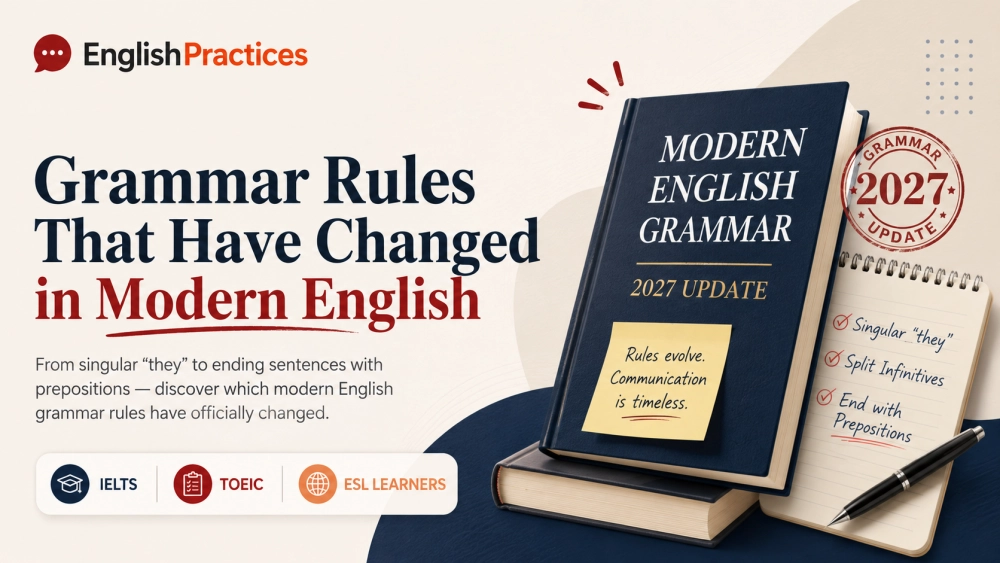
Quick Answer: Several widely taught English grammar rules have been officially revised. Singular "they" is now the accepted gender-neutral pronoun, endorsed by the AP Stylebook, APA, and Merriam-Webster. Ending a sentence with a preposition is no longer an error. Split infinitives are accepted — even preferred — when they produce clearer meaning. Starting a sentence with "And" or "But" is grammatically sound in most writing contexts today.
Introduction
If a teacher once told you "never end a sentence with a preposition," you were handed a rule that linguists never actually agreed on. English has always been a living system, shaped by usage, culture, and time. But in the past decade, the pace of formal change has accelerated. Major authorities — the Associated Press, the American Psychological Association, the Chicago Manual of Style, and Oxford — have revised their standards in ways that affect how you write, how you are graded on exams, and how you are perceived in professional settings.
This matters enormously if you are preparing for IELTS or TOEIC, studying English in Thailand, Vietnam, South Korea, Japan, Mexico, Singapore, or anywhere else in a global market, or trying to write with confidence in a workplace that spans multiple English-speaking cultures. Knowing the difference between a rule that has changed and a rule that still stands is the difference between sounding natural and sounding like a 1970s grammar textbook.
In this 2027 update, EP. breaks down six major grammar shifts, explains what they mean for exam candidates specifically, and tells you which foundational rules have not changed — because precision still matters. No jargon. No fluff. Just clarity.
Why English Grammar Rules Change — And Why You Should Care
Grammar operates on two philosophies. Prescriptive grammar dictates one correct form and expects everyone to follow it. Descriptive grammar observes how educated speakers and writers actually use the language, then updates the standards to reflect that reality.
For most of the twentieth century, prescriptive grammar ruled classrooms from London to Lagos to Tokyo. If a textbook prohibited splitting an infinitive, that prohibition was law — regardless of whether professional writers, journalists, or scholars actually followed it. The problem? They often did not.
By the early 2000s, the major style guides began catching up with the language as it was genuinely being used. Organizations like the AP, APA, Chicago, and Oxford now update their recommendations based on evidence from real writing. The result is a set of grammar standards that is more accurate, more flexible, and — in some respects — more demanding than the old prescriptive model.
Before diving into the specific changes, if you want a comprehensive reference that covers every grammar area in one place, the complete English grammar guide at EnglishPractices.com is built exactly for that purpose — from beginners through advanced exam candidates.
6 Grammar Rules That Have Officially Changed in Modern English
1. Singular "They" Is Now the Standard Gender-Neutral Pronoun
This is the single largest grammar revision of the past decade, and its adoption has been swift.
For generations, students learned to use "he" as the default singular pronoun for an unspecified person: "Every student must submit his assignment by Friday." That rule has been formally retired across all major style guides.
The AP Stylebook added singular "they" to its editorial standards in 2017. The American Psychological Association endorsed it in the APA 7th edition (2019). Merriam-Webster named "they" — used as a singular — its Word of the Year in 2019, and the American Dialect Society voted it Word of the Decade for 2010–2019. Perhaps most compellingly, the Oxford English Dictionary traces singular "they" back to 1375, with documented use by Chaucer, Shakespeare, and Jane Austen long before any prescriptive grammarian tried to ban it.
| Context | Old Teaching | Modern Standard |
|---|---|---|
| Unknown gender | "Every student must submit his work." | "Every student must submit their work." |
| Non-binary identity | No standard existed | "They" is used and grammatically correct |
| Indefinite reference | "Someone left his bag." | "Someone left their bag." |
For IELTS and TOEIC candidates: Singular "they" is accepted on both exams. Subject-verb agreement still applies — always write "they are," not "they is," even when referring to a single individual. This distinction is non-negotiable.
2. You Can End a Sentence with a Preposition
"What did you come up with?" is clear, natural English. "With what did you come up?" is technically precise — and almost nobody uses it in speech or professional writing.
The prohibition against ending sentences with prepositions was borrowed from Latin grammar by 17th-century scholars and applied to English without linguistic justification. Latin is a highly inflected language where word order is flexible and endings carry grammatical meaning. English is not. The rule was never valid for English grammar, and the Chicago Manual of Style (17th edition) says as much plainly, calling the restriction an unnecessary pedantry that good writers have ignored for centuries.
Old rule: "This is a situation about which I am deeply concerned." Modern standard: "This is a situation I am deeply concerned about."
Both sentences are correct today. In highly formal academic or legal writing, avoiding the sentence-final preposition is occasionally a stylistic preference — but it is never an error, and artificially restructuring sentences to avoid it often produces awkward, unnatural prose.
3. Split Infinitives Are Acceptable — Often Preferable
A split infinitive places an adverb between "to" and the main verb: "to clearly explain," "to boldly go," "to fully understand." The rule against splitting infinitives was imposed by 19th-century grammarians who looked to Latin for structural authority. In Latin, infinitives are single words — literally unsplittable. In English, they are two words, and inserting an adverb between them is often the clearest way to express emphasis.
Chicago explicitly endorses split infinitives when they produce better clarity. The AP Stylebook follows the same position. Every major English authority agrees.
Old rule: "She tried clearly to explain the process." (Ambiguous: does "clearly" modify "tried" or "explain"?) Modern standard: "She tried to clearly explain the process." (Unambiguous: "clearly" modifies "explain.")
The split infinitive removes ambiguity. That alone justifies it. For exam candidates: a split infinitive in your IELTS Writing Task will not be penalized. Attempting to "uncorrect" one can actually reduce the clarity of your sentence.
4. Starting a Sentence with "And," "But," or "Because" Is Grammatically Sound
This rule survives almost entirely because of how it was taught to children. Teachers discouraged sentence-initial conjunctions to stop students from writing fragments. The pedagogical concern was reasonable. The grammatical prohibition was not.
The Chicago Manual of Style states directly that there is no rule against beginning a sentence with a conjunction. AP agrees. Skilled writers — from George Orwell to Toni Morrison to contemporary journalists — have used this technique deliberately for centuries to control rhythm and emphasis.
Old rule: Sentences must not begin with "And," "But," or "Because." Modern standard: These conjunctions can open sentences in both formal and informal writing, provided the sentence that follows is grammatically complete and the usage is intentional.
The key word is intentional. Using "And" or "But" at the start of a sentence for effect is stylistically powerful. Using it because you did not know how to connect your ideas is a different matter entirely.
5. "Data" Can Now Be Used as a Singular Noun in General Writing
Technically, "data" is the Latin plural of "datum." For decades, formal grammar required: "The data are consistent with the hypothesis." In scientific and academic publishing, this convention still holds, and for good reason — precision in those contexts is non-negotiable.
In general business writing, journalism, and technology, however, "data" has evolved into a mass noun — similar to "information" or "evidence" — that takes a singular verb. The AP Stylebook explicitly supports treating "data" as singular in non-scientific contexts. Most major newspapers, technology companies, and professional publications now write "the data is" without a second thought.
Old rule: "The data are showing a consistent pattern." (Required in all contexts) Modern standard: "The data is showing a consistent pattern." (Accepted in non-scientific writing)
For IELTS Academic candidates: Stick with plural. Academic writing conventions still treat "data" as plural, and your examiner will expect that standard.
6. "Who" Is Replacing "Whom" in Everyday English
"Whom" is not wrong. But "who" is increasingly correct in informal and semi-formal contexts, and its use is spreading even into formal speech. The traditional rule is straightforward: use "whom" when the pronoun functions as the object of a verb or preposition ("To whom should I address this?"). Use "who" when it functions as the subject ("Who called?").
In practice, most native English speakers use "who" in all positions, and modern style guides accept this in conversational and informal contexts. "Who did you speak to at the conference?" is natural, clear, and widely accepted in modern English.
The distinction still carries weight in formal writing and on exams. In fact, correctly using "whom" where it is required is a signal of grammatical sophistication — which is exactly what IELTS Band 7 and above descriptors reward. For this reason, understanding relative clauses — which govern where "who" and "whom" appear — remains essential for advanced learners.
What IELTS and TOEIC Students Specifically Need to Know
Here is the honest reality: standardized exams lag behind living language by design. They test formal, written grammar — which means some of these "changed" rules still behave like the old rules on test day. The table below cuts through the ambiguity.
| Grammar Rule | Traditional Teaching | What Modern Style Guides Say | Exam Impact |
|---|---|---|---|
| Singular "they" | Use "he" as default | Fully accepted and preferred | Accepted on IELTS and TOEIC |
| Preposition at sentence end | Always avoid | Fully accepted | Not penalized — clarity is primary |
| Split infinitives | Always avoid | Accepted when clearer | Not penalized |
| Sentence-initial "And/But" | Prohibited | Accepted with intention | Not penalized if sentence is complete |
| "Data" singular or plural | Always plural | Singular accepted in general use | Use plural in IELTS Academic |
| "Who" vs. "Whom" | Strict distinction required | "Who" accepted informally | "Whom" still rewarded at Band 7+ |
The takeaway is straightforward. Modern grammar gives you more flexibility in writing and speech. But knowing the formal standard still provides an edge on exams and in professional contexts. Understanding both — the evolved rule and the traditional expectation — means you can adapt to any audience with confidence.
UK vs. US English: The Grammar Gap That Affects Your Exam Score
One of the most practically important grammar differences for global learners is the widening divergence between British and American English in tense usage. This is less a "changed rule" than a growing split between two established standards — and knowing which one your exam follows can directly affect your score.
British English uses the present perfect for recently completed actions and experiences that feel connected to the present. American English increasingly uses the past simple in the same contexts.
| Situation | British English (BrE) | American English (AmE) |
|---|---|---|
| Recent completed action | "I've just eaten." | "I just ate." |
| Experience up to now | "I've been to Japan three times." | "I went to Japan three times." |
| Finished event with present relevance | "Have you seen the news today?" | "Did you see the news today?" |
For IELTS candidates: The exam follows British English conventions. Using past simple where present perfect is expected can reduce your Writing and Speaking scores. Understanding how to master the present perfect is non-negotiable at Band 6.5 and above.
For TOEIC candidates: The exam aligns more closely with American English. Past simple is more commonly used in TOEIC reading and listening passages for completed actions.
Knowing which standard your exam follows is not a minor detail. It is a strategic decision that separates test-takers who plateau from those who score.
Grammar Rules That Have NOT Changed — Stay Sharp on These
Change is real, but it is not universal. Several foundational grammar rules remain exactly as they were — and errors here will cost you marks on exams and credibility in professional writing.
These rules remain unchanged in 2027:
-
Subject-verb agreement. "She runs" not "She run." This is non-negotiable in all varieties of English, formal and informal.
-
Tense consistency. Randomly mixing tenses within a paragraph is an error in all formal writing contexts. No style guide has revised this.
-
Article usage. The rules governing "a," "an," and "the" are stable and heavily tested on both IELTS and TOEIC. The complete guide to articles in English covers every nuance, including zero article usage and the difference between specific and generic reference.
-
Conditional structures. First, second, and third conditionals in English follow established patterns that have not shifted. Mixing conditional types creates meaning errors — not stylistic choices.
-
Modal verbs. The semantic distinctions between modal verbs — can/could, will/would, shall/should, must/might — remain precise and consequential in professional writing and on both major exams.
-
Reported speech backshift. The tense-shift rules in reported speech are stable and appear regularly in IELTS Reading and TOEIC Listening sections.
Knowing what has changed helps you sound natural. Knowing what has not changed keeps you accurate. You need both.
The EnglishPractices.com Approach: Grammar That Grows with the Language
At EP., the team has spent 19 years working with English learners across the UK, North America, Thailand, Vietnam, South Korea, Japan, Singapore, Mexico, and China. One pattern stands out across every market and every level: students who understand why grammar works the way it does learn faster, retain more, and adapt confidently when the rules shift beneath them.
That is the philosophy behind every guide on EnglishPractices.com. Whether you are reviewing the passive voice for IELTS Academic Task 1, working through present simple vs. present continuous for day-to-day communication, or studying conditionals for professional email writing, the goal is consistent: give you a framework you can trust even when the language around you keeps shifting.
Grammar is not a museum exhibit behind glass. It is a living system — and understanding it deeply means you can handle any version of it that crosses your desk, your exam paper, or your inbox.
Your Next Steps
Start with the complete English grammar guide by EP. for a structured overview of every major grammar area covered in this article, built to take you from foundational rules through exam-level application.
If you have a specific grammar challenge — an upcoming IELTS exam, a professional writing project, or a particular rule that keeps tripping you up — reach out to the team at EnglishPractices.com. Real experts. Practical feedback. Zero automated responses.
Related Grammar Resources
-
Complete English Grammar Guide — The full-coverage pillar for every level
-
Mastering the Present Perfect — Essential for IELTS Band 6.5+
-
Prepositions of Time, Place, and Movement — The most misunderstood grammar category for ESL learners
-
Relative Clauses: Defining vs. Non-Defining — Who, whom, which, and that — clarified
-
Conjunctions in English — How connectors shape meaning and flow
-
Past Simple vs. Past Perfect — The tense distinction that confuses advanced learners most