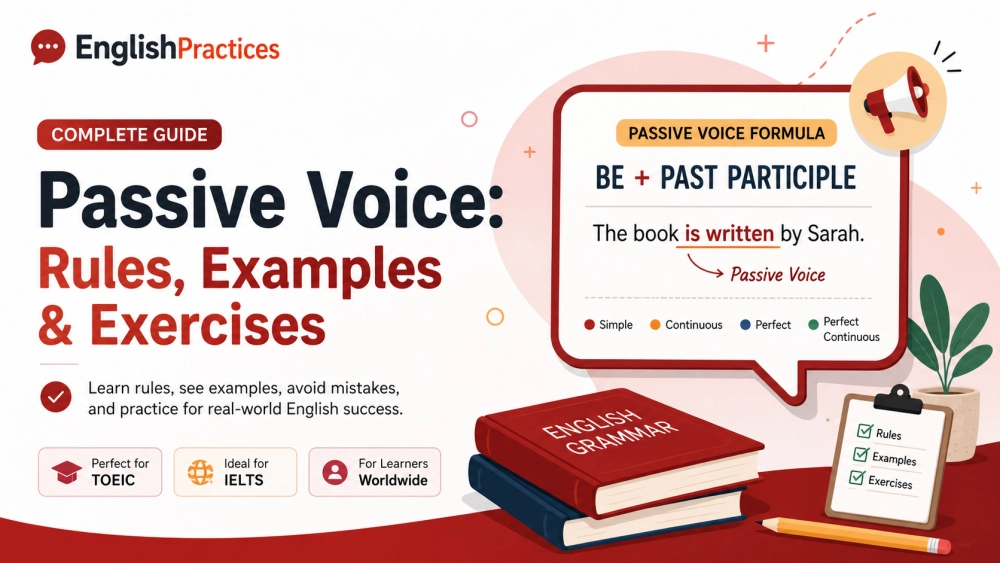
Millions of English learners worldwide — from classrooms in Seoul and Ho Chi Minh City to test centers in London and New York — face the same question: why does this sentence feel different? Why does "Mistakes were made" sound more formal than "We made mistakes"? The answer, almost every time, is passive voice.
Passive voice in English is a sentence structure where the subject receives the action rather than performs it. It is one of the most tested, most useful, and most misunderstood structures in the language — central to TOEIC, IELTS, academic writing, and professional communication across every industry and country.
This guide gives you everything: the core formula, a tense-by-tense breakdown, when to use it (and when not to), exam-ready strategies for TOEIC and IELTS, common mistakes to avoid, and exercises you can start right now. Whether you are a complete beginner or a learner aiming for IELTS Band 7+, think of this as the passive voice reference you return to again and again.
What Is Passive Voice? (Direct Answer)
Passive voice occurs when the grammatical subject of a sentence is the receiver of the action, not the performer.
Core Formula: Subject + [to be — conjugated to tense] + [Past Participle] + (by + agent — optional)
Example: "The report was written by the team."
The agent — the person or thing performing the action — is optional. Include it only when it adds meaningful information.
Compare the two constructions side by side:
- Active: The team wrote the report. (focus: the team)
- Passive: The report was written by the team. (focus: the report)
Both sentences carry the same information. The difference lies entirely in emphasis and focus — and that choice matters far more than most learners realize.
Active Voice vs. Passive Voice: What Is the Real Difference?
Most grammar teachers draw a clean line between active and passive, explaining it purely as a structural swap. That is a useful starting point, but the deeper truth is about what you want to emphasize — the doer, or the result of the action.
In everyday conversation, active voice dominates because it is direct and energetic. In formal writing — academic journals, business reports, legal documents, and news articles — passive voice appears consistently, because it shifts focus to the information that matters most. The performer becomes secondary, or disappears entirely.
A clear real-world example: a UK government press release might say "The budget was reduced by 12%" rather than "The Treasury reduced the budget by 12%." The passive version keeps focus on the outcome, and it avoids assigning political responsibility. That is not an accident — it is a deliberate stylistic choice that skilled writers make every day.
| Feature | Active Voice | Passive Voice |
|---|---|---|
| Focus | The performer (subject) | The receiver (object) |
| Formality | Casual to formal | More formal, academic |
| Common Context | Conversation, storytelling | Science, business, news, law |
If you want to see how passive voice connects to the broader framework of English grammar, the Complete English Grammar Guide at EP. offers a complete reference from beginner to advanced level.
How to Form Passive Voice: The Core Rules
Every passive sentence — regardless of tense — follows the same internal logic. You need two elements working together:
- The correct form of "to be" — matching the tense and the subject number (singular or plural)
- The past participle of the main verb — this form does not change across tenses; what changes is "to be"
Master Formula: Subject + [correct form of "to be"] + [past participle] + (by + agent)
Three rules that eliminate most passive voice errors:
- Subject-verb agreement still applies. "The email is sent" (singular) vs. "The emails are sent" (plural). The subject controls the form of "to be," not the verb.
- The past participle is fixed. "written," "sent," "approved," "built" — these forms do not change with tense. Many learners confuse the simple past form with the past participle. They are not always the same: "wrote" is simple past; "written" is the past participle.
- The agent is optional — and often omitted. Leave out "by + agent" when the performer is unknown, obvious, or irrelevant. This is extremely common in formal and academic English.
Passive Voice Across All Tenses: Complete Reference Table
| Tense | Passive Formula | Passive Example |
|---|---|---|
| Present Simple | am/is/are + past participle | The office is cleaned daily. |
| Present Continuous | am/is/are being + past participle | The email is being written. |
| Past Simple | was/were + past participle | The machine was fixed. |
| Past Continuous | was/were being + past participle | The software was being tested. |
| Present Perfect | has/have been + past participle | The project has been completed. |
| Past Perfect | had been + past participle | The invoice had been sent. |
| Future Simple | will be + past participle | The package will be delivered. |
| Future Perfect | will have been + past participle | The work will have been finished. |
| Modal Verbs | modal + be + past participle | The form must be submitted. |
PP = Past Participle
Pro tip: The present perfect passive ("has/have been + past participle") deserves special attention. It appears frequently in IELTS Writing Task 1 when describing changes over time — for example, "The city has grown rapidly" can be restructured as "Rapid growth has been recorded in the urban area." This is a high-value construction for academic writing. The EP. deep-dive on Present Perfect Tense explains this aspect in full, including tricky usage points that catch even intermediate learners off guard.
For the critical distinction between past simple and past perfect in passive structures — "was completed" vs. "had been completed" — see the guide on Past Simple vs Past Perfect.
When to Use Passive Voice (And When to Avoid It)
Passive voice is a tool, not a mistake. The question is not whether to use it — it is when to use it, and why.
Use passive voice when:
- The performer of the action is unknown: "The window was broken overnight."
- The performer is obvious or unimportant: "The suspect was arrested." (Obviously by police — no need to state it.)
- You need a formal, impersonal tone: "The samples were analyzed over a 48-hour period."
- Assigning blame would be inappropriate: "An error was made in the calculation." (Common in corporate communication across the UK, US, Japan, and South Korea.)
- The result matters more than the actor: "The new headquarters has been approved."
Avoid passive voice when:
- The sentence becomes unnecessarily long or hard to follow
- Your reader needs to know clearly who is responsible for an action
- You are writing in a casual, conversational style
- Multiple passive constructions in a row make the writing feel slow and distant
The common advice — "always avoid passive voice" — is an oversimplification that misleads learners. Passive voice is standard in scientific journals, formal reports, academic essays, and legal writing globally. Using it well is what distinguishes a competent English user from an excellent one.
The EP. guide on Present Simple vs Present Continuous also explores how verb aspect choices shape formality and meaning — a concept directly connected to passive voice decisions.
Passive Voice in Conditionals and Reported Speech
Two grammar areas where passive voice regularly appears — and regularly causes confusion — are conditional sentences and reported speech.
In conditional structures, passive voice integrates naturally and adds appropriate formality:
- Zero conditional: "If data is entered incorrectly, errors are generated automatically."
- Second conditional: "If the proposal were approved, new facilities would be constructed."
- Third conditional: "If the budget had been increased, the project would have been completed on time."
For a full breakdown of all conditional types and their structures, the EP. resource on Conditionals in English is your complete reference.
In reported speech, passive verbs shift tenses according to the same backshift rules as active verbs. This is where learners frequently make errors:
| Direct Speech | Reported Speech |
|---|---|
| "The meeting has been postponed." | She said the meeting had been postponed. |
| "The report was submitted." | He mentioned the report had been submitted. |
| "The results will be announced." | They said the results would be announced. |
This backshift pattern appears frequently in IELTS Listening and Reading, and in TOEIC Part 4 (talks). The full guide on Reported Speech Rules covers every backshift scenario with detailed examples.
Passive Voice in TOEIC and IELTS: Exam Strategies That Work
If you are preparing for either of these exams, passive voice is not optional content — it is a core structure tested across multiple question types.
| Aspect | TOEIC | IELTS |
|---|---|---|
| Main Test Section | Part 5 — Sentence Completion | Writing Task 1 and Task 2 |
| Most Tested Form | Past simple passive (was/were + PP) | Present perfect passive (has/have been + PP) |
| Common Trap | Confusing active vs. passive verb form | Missing or incorrect auxiliary verb |
TOEIC Strategy
TOEIC Part 5 regularly presents passive voice as a precision grammar trap. A typical question looks like this:
"The annual report _______ by the board of directors last Friday." A) reviewed B) was reviewed C) is reviewed D) reviewing
The correct answer is B — was reviewed. The time marker "last Friday" signals past simple, and the subject "annual report" is the receiver, not the doer. Questions like this reward learners who simultaneously identify tense and voice — which is a skill that requires practice, not just memorization.
IELTS Strategy
IELTS Writing Task 1 (Academic) almost always requires describing a process or change over time — contexts where passive voice is the natural and expected structure. IELTS assessment criteria, published by Cambridge Assessment English, explicitly reward candidates who demonstrate a wide grammatical range and accuracy. Passive voice is a central part of that range for learners targeting Band 7 and above.
In IELTS Writing Task 2, passive constructions help create the impersonal, academic register that higher-band essays require. A sentence like "It has been argued that economic growth does not guarantee social equality" is far more appropriate in a formal essay than "Many people think economic growth doesn't guarantee equality."
For learners specifically targeting Band 7+, the EP. resource on Mastering Present Perfect covers the perfect aspect in depth — including its passive forms and the nuances that examiners reward.
Common Passive Voice Mistakes and How to Fix Them
These errors appear consistently across thousands of practice submissions reviewed at EP. — from learners in Vietnam, Japan, Korea, Thailand, Mexico, and China. Recognizing them is half the battle.
Mistake 1: Missing the auxiliary verb "to be"
- ❌ "The contract signed yesterday."
- ✅ "The contract was signed yesterday."
Mistake 2: Wrong agreement between subject and "to be"
- ❌ "The files was sent this morning."
- ✅ "The files were sent this morning." (plural subject → were)
Mistake 3: Using simple past instead of past participle
- ❌ "The window was broke."
- ✅ "The window was broken."
Mistake 4: Including an unnecessary agent
- ❌ "The exam was completed by the students." (who else would complete it?)
- ✅ "The exam was completed." (cleaner and more natural)
Mistake 5: Applying passive to intransitive verbs
Not all verbs can take a passive form. Intransitive verbs — those that do not take a direct object — cannot be made passive. This is one of the most misunderstood rules in English grammar.
- ❌ "The accident was happened at midnight." (happen is intransitive)
- ✅ "The accident happened at midnight."
Other common intransitive verbs that cannot be made passive: arrive, occur, exist, die, sleep, appear, disappear, consist.
Passive Voice in 2026: Why This Structure Is More Relevant Than Ever
As AI writing tools — from Grammarly to browser-based writing assistants — become standard in classrooms from Bangkok to São Paulo, passive voice detection is increasingly automated. But here is what those tools cannot do: they cannot tell you why the passive is the better choice in a specific context. That judgment belongs to you, and it requires real understanding.
In 2026, English-medium academic programs are expanding rapidly across Southeast Asia and East Asia. Universities in Singapore, South Korea, Thailand, and Vietnam are requiring students to submit coursework in formal written English — where passive voice is a baseline expectation, not a stylistic option. Learners who understand this structure deeply have a measurable advantage, both in standardized exams and in professional life after graduation.
The ability to choose passive voice intentionally — rather than stumble into it accidentally — is what separates intermediate users from truly proficient ones.
Passive Voice Exercises: Practice Right Now
Exercise 1 — Convert to Passive
Rewrite each sentence in passive voice. Omit the agent unless it adds meaningful information.
- The company has launched a new product.
- Someone is repairing the broken machine right now.
- The government will introduce new regulations next year.
- They had already sent the invoice before the meeting.
- The lab analyzed the samples twice.
Exercise 2 — Fill in the Blank
Choose the correct passive form based on the tense indicated in brackets.
- The report _______ (finalize — present perfect passive) and is ready to review.
- New offices _______ (build — future simple passive) in the city center next year.
- The documents _______ (review — past continuous passive) when the meeting started.
- All questions _______ (answer — present simple passive) within 24 hours.
Exercise 3 — Spot and Fix the Error
Each sentence contains one error. Find it and correct it.
- "The budget was been approved by the committee."
- "The new policy announced last week."
- "Three candidates was interviewed yesterday."
✅ Answer Key
Exercise 1:
- A new product has been launched.
- The broken machine is being repaired right now.
- New regulations will be introduced next year.
- The invoice had already been sent before the meeting.
- The samples were analyzed twice.
Exercise 2:
- has been finalized
- will be built
- were being reviewed
- are answered
Exercise 3:
- "The budget was approved by the committee." — Remove "been"; was + been is not a valid passive form.
- "The new policy was announced last week." — Missing auxiliary verb "was."
- "Three candidates were interviewed yesterday." — Plural subject "candidates" requires "were," not "was."
Conclusion: Passive Voice Is a Choice, Not a Chance
Passive voice is not a difficult structure once you see it for what it is — a deliberate shift in focus. You use it when the result matters more than the doer, when formality is required, or when the performer is unknown or irrelevant. You avoid it when clarity is the priority and the reader needs to know exactly who did what, and why.
The learners who perform best on TOEIC, IELTS, and in professional English environments are not those who memorized every rule. They are the ones who understood the reasoning behind those rules well enough to apply them confidently in any context. That is exactly what this guide aims to give you.
EnglishPractices.com has supported English learners across the UK, North America, Southeast Asia, East Asia, and Latin America for over 19 years. The grammar resources at EP. are built on one principle: clarity first, confidence always.
Your next step: Work through the exercises above, revisit the tense table until it feels natural, and test yourself with the quiz below. Then explore the full grammar library at EnglishPractices.com to find the resources that match your current level and your goals.