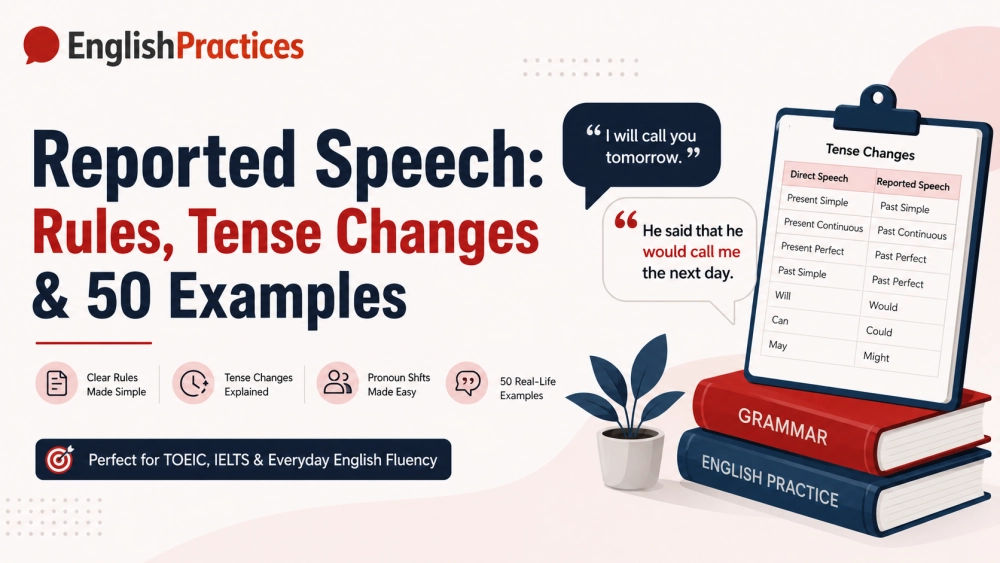
Reported speech is one of those grammar topics that trips up learners at every level — not because it is complicated, but because most explanations treat it as a collection of rules to memorise rather than a logical system to understand. The truth is simpler: reported speech is how you tell someone what another person said, without repeating their exact words. The verb tense shifts back. Pronouns change. Time expressions adjust. Once you see the pattern, the rest clicks into place.
Whether you are a student in Vietnam, Korea, Thailand, or the UK preparing for TOEIC or IELTS, or a professional in Mexico, Singapore, China, or Japan who wants sharper English communication skills — this guide gives you the full system. You will get clear rules, a complete tense change table, and 50 worked examples you can use as a practice set right now.
Secondary Keywords Covered: reported speech rules, direct and indirect speech, tense changes in reported speech, indirect speech examples, backshifting in English, reporting verbs, reported questions, IELTS reported speech, TOEIC indirect speech.
What Is Reported Speech in English?
Quick Answer: Reported speech (also called indirect speech) is a grammatical structure that conveys what someone said without quoting their exact words. The verb tense typically shifts back one step, pronouns change to reflect the new speaker's perspective, and time/place expressions are adjusted accordingly.
Direct Speech: "I am studying for my exam," she said. Reported Speech: She said she was studying for her exam.
Three words changed: am → was, my → her, and the quotation marks disappeared. That shift — driven by consistent rules — is what this guide unpacks completely.
Direct Speech vs. Reported Speech: The Core Difference
Direct speech quotes the original speaker's exact words inside quotation marks. Reported speech removes those quotation marks and integrates the message grammatically into the sentence. The meaning is identical; the structure changes.
| Feature | Direct Speech | Reported Speech |
|---|---|---|
| Quotation marks | Yes | No |
| Verb tense | Original tense used | Backshifted one step back |
| Pronouns | Speaker's first-person view | Adjusted to reporter's perspective |
| Time/place expressions | Now, today, here, this | Then, that day, there, that |
Think of it this way: direct speech is a photograph of the exact moment. Reported speech is a written summary of that photograph — same content, different frame.
For a complete overview of how reported speech fits into the broader English grammar system, Complete English Grammar Guide is the essential starting point EP recommends for all learners.
The Backshift Rule: Tense Changes in Reported Speech
Tense backshifting is the core mechanic of reported speech. When you report what someone said — especially after some time has passed — you push the verb one step back in time. The logic is intuitive: the original speech happened in the past, so the tense reflects that.
Important exception first: If the reporting verb is in the present tense (e.g., She says...), no backshift is needed. Backshifting only applies when the reporting verb is in the past tense (e.g., She said...).
Here is the complete tense shift reference table:
| Direct Speech Tense | Example | Reported Speech Tense | Reported Example |
|---|---|---|---|
| Present Simple | "I work here." | Past Simple | She said she worked there. |
| Present Continuous | "I am working." | Past Continuous | She said she was working. |
| Present Perfect | "I have finished." | Past Perfect | She said she had finished. |
| Past Simple | "I went home." | Past Perfect | She said she had gone home. |
| Past Continuous | "I was reading." | Past Perfect Continuous | She said she had been reading. |
| Past Perfect | "I had eaten." | Past Perfect (no change) | She said she had eaten. |
| Will | "I will call." | Would | She said she would call. |
| Can | "I can help." | Could | She said she could help. |
| May | "I may leave." | Might | She said she might leave. |
| Must | "I must go." | Had to | She said she had to go. |
| Should | "I should rest." | Should (no change) | She said she should rest. |
Notice that past perfect and should do not change — they are already at the "furthest back" position in the tense system.
Understanding the relationship between past simple and past perfect is critical here. If you want to solidify that foundation, Past Simple vs Past Perfect explains exactly when and why each tense is used — which directly supports your reported speech accuracy.
Pronoun Changes in Reported Speech
Pronouns shift to reflect the new speaker's perspective. This is the area where learners make the most natural but most visible mistakes. The rule is simple: think about who is now speaking and who is now listening.
| Direct Speech | Reported Speech |
|---|---|
| I | he / she |
| me | him / her |
| my | his / her |
| we | they |
| us | them |
| our | their |
| you (addressed to reporter) | I / me / my |
| you (addressed to third party) | he / she / him / her |
Example:
"I left my bag at your office," Tom told me. → Tom told me he had left his bag at my office.
The pronoun swap requires you to think from the reporter's point of view, not the original speaker's. It is a perspective shift as much as a grammar rule.
Time and Place Expression Changes
When you report speech, words that anchor the original statement in time and place also need to shift. What was now for the original speaker is then for the person reporting.
| Direct Speech Expression | Reported Speech Expression |
|---|---|
| now | then |
| today | that day |
| yesterday | the day before / the previous day |
| tomorrow | the next day / the following day |
| this week | that week |
| last year | the previous year |
| next month | the following month |
| here | there |
| this | that |
| these | those |
Example:
"I will submit this report tomorrow." → He said he would submit that report the next day.
Reporting Verbs: Beyond "Said" and "Told"
Most learners default to said and told for everything — but English gives you a much richer toolkit. Choosing the right reporting verb adds precision, shows intent, and significantly boosts your score in IELTS Writing and Speaking tasks.
Neutral reporting:
- said, told, stated, mentioned
Strong assertion:
- claimed, insisted, maintained, argued
Reluctant acknowledgement:
- admitted, confessed, acknowledged
Rejection or refusal:
- denied, refused
Future commitment:
- promised, vowed, swore
Warning or advice:
- warned, advised, urged, cautioned
Suggestion or recommendation:
- suggested, recommended, proposed
Explanation or description:
- explained, described, pointed out, noted
Question or enquiry:
- asked, enquired, wondered, questioned
Instruction or command:
- ordered, commanded, instructed, directed
"Don't go near the construction site," the manager said. → The manager warned us not to go near the construction site.
Notice how warned carries more meaning than said. That single word communicates intent — and that is the difference between basic and advanced reported speech. These verbs also interact with conditional structures, which Conditionals in English covers in detail.
50 Examples of Reported Speech in English
These 50 examples are organized by structure type. For each, read the direct version first, then cover it and try to produce the reported version yourself before checking.
Statements: Present to Past (Examples 1–15)
- "I am happy." → She said she was happy.
- "We live in London." → They said they lived in London.
- "He works at a bank." → She said he worked at a bank.
- "I like coffee." → He said he liked coffee.
- "They are watching TV." → She said they were watching TV.
- "I am studying for my exam." → He said he was studying for his exam.
- "She sings beautifully." → He said she sang beautifully.
- "I don't understand this." → He said he didn't understand that.
- "We are planning a trip." → They said they were planning a trip.
- "I love my job." → She said she loved her job.
- "He doesn't eat meat." → She said he didn't eat meat.
- "They are moving to Seoul." → He said they were moving to Seoul.
- "I speak three languages." → She said she spoke three languages.
- "We enjoy hiking." → They said they enjoyed hiking.
- "She is feeling better." → He said she was feeling better.
Past Simple to Past Perfect (Examples 16–25)
- "I visited Tokyo last year." → She said she had visited Tokyo the previous year.
- "He called me this morning." → She said he had called her that morning.
- "We finished the project." → They said they had finished the project.
- "I forgot my password." → He said he had forgotten his password.
- "She graduated in June." → He said she had graduated in June.
- "I saw that film." → He said he had seen that film.
- "They arrived late." → She said they had arrived late.
- "I lost my keys." → She said she had lost her keys.
- "He missed the meeting." → She said he had missed the meeting.
- "We won the competition." → They said they had won the competition.
Future and Modal Changes (Examples 26–35)
- "I will call you tomorrow." → She said she would call me the next day.
- "We can solve this problem." → They said they could solve that problem.
- "He may be late." → She said he might be late.
- "I must submit the form today." → She said she had to submit the form that day.
- "They will arrive soon." → She said they would arrive soon.
- "I can speak Japanese." → He said he could speak Japanese.
- "You should rest more." → The doctor said I should rest more.
- "We might cancel the event." → They said they might cancel the event.
- "I will help you." → She said she would help me.
- "He must apologize." → She said he had to apologize.
Reported Questions (Examples 36–42)
Reported questions use statement word order (Subject + Verb). The question mark disappears. Yes/no questions use if or whether.
- "Where do you live?" → She asked where I lived.
- "Are you coming to the party?" → He asked if I was coming to the party.
- "What time does the train leave?" → She asked what time the train left.
- "Do you speak English?" → He asked if I spoke English.
- "Why are you crying?" → She asked why I was crying.
- "Have you eaten yet?" → He asked if I had eaten yet.
- "Who called you?" → She asked who had called me.
Reported Commands and Requests (Examples 43–47)
Reported commands follow this pattern: verb + object + (not) + to-infinitive.
- "Please close the window." → She asked me to close the window.
- "Don't be late." → He told me not to be late.
- "Sit down." → The teacher told the students to sit down.
- "Please send me the file." → He asked her to send him the file.
- "Don't touch that." → She warned him not to touch that.
Mixed and Advanced Examples (Examples 48–50)
- "I have been waiting for two hours," he complained. → He complained that he had been waiting for two hours.
- "If I had more time, I would travel more," she admitted. → She admitted that if she had had more time, she would have traveled more.
- "We have never visited Vietnam," they said. → They said they had never visited Vietnam.
Common Mistakes in Reported Speech (And How to Fix Them)
Even advanced learners slip here. These are the four errors EP sees most consistently across thousands of students globally.
Mistake 1: Forgetting to backshift the tense ❌ She said she is tired. ✅ She said she was tired.
Mistake 2: Using question word order in reported questions ❌ He asked where did I live. ✅ He asked where I lived.
Mistake 3: Keeping the original time expression ❌ She said she would call tomorrow. ✅ She said she would call the next day.
Mistake 4: Confusing "said" and "told" ❌ She said me she was leaving. ✅ She told me she was leaving. / She said she was leaving.
Said stands alone or is followed by that. Told always requires a person object. This is one of the most consistent errors in TOEIC Part 5 gap-fill questions.
The present perfect-to-past-perfect shift in Mistake 1 is covered in depth at Present Perfect Tense — a highly recommended read before your next exam attempt.
Reported Speech for TOEIC and IELTS in 2026: What Has Changed
In 2026, both the TOEIC and IELTS have placed increasing weight on discourse-level grammar — meaning examiners now look at how you handle language across full sentences and paragraphs, not just single correct answers. Reported speech sits right at the centre of this shift.
In TOEIC:
- Part 7 (Reading): Emails, memos, and meeting reports frequently involve one person summarising what another said. Recognising reported structures helps you track meaning across multiple texts — which is exactly what the triple-passage questions require.
- Parts 3 & 4 (Listening): Speakers often report instructions, decisions, and announcements. Knowing reporting verbs such as confirmed, warned, suggested gives you a major comprehension advantage when the audio moves quickly.
In IELTS:
- Writing Task 2: Using varied reporting verbs (researchers suggest, critics argue, evidence indicates) raises your Lexical Resource score. Formulaic use of said throughout an essay signals weak range.
- Speaking Part 3: Reporting others' views (Many people believe... / Some experts argue...) is a reliable strategy for extended, fluent answers at Band 7+.
- Reading: Academic texts frequently embed reported speech structures in summaries and paraphrases. Misreading a backshifted tense can cause you to misattribute a claim.
Understanding how the present perfect transitions into reported structures — and why — is also crucial. Mastering Present Perfect builds exactly that foundation, and EP includes it as a prerequisite module before reported speech in the structured curriculum.
Direct Quotation vs. Reported Speech: Which Should You Use?
In writing, you have a clear choice between quoting directly and reporting. Both are correct; they serve different purposes.
Use direct quotation when:
- The exact wording is significant (legal documents, journalism, creative writing)
- You want dramatic emphasis or a vivid voice
- You are analysing someone's specific word choices
Use reported speech when:
- Writing in an academic or professional register
- Paraphrasing for IELTS or TOEIC tasks
- Summarising in emails, reports, or meeting notes
- You want a smoother, more formal flow
In IELTS Academic Writing, business emails, and professional reports, reported speech is almost always the preferred form. Direct quotes can feel abrupt in formal writing unless used with clear intent.
The interplay between Present Simple vs Present Continuous] is also relevant here — because recognising which tense was originally used determines how you backshift it in the reported version.
The "No Backshift" Exception: When Tenses Stay the Same
There is one important exception worth knowing — and it appears regularly in IELTS academic writing.
When the reported information is still true at the time of reporting, backshifting is optional:
"Water boils at 100°C," the teacher explained. → The teacher explained that water boils (or boiled) at 100°C.
Since the fact remains true today, both tenses are acceptable. In scientific and academic writing, the present tense is often retained to signal that the information is currently valid.
This also applies when the reporting verb is in the present tense:
She says she is tired. (No backshift needed — present reporting verb.)
Knowing this exception prevents over-correction — a mistake that catches many B2-level learners who have learned the rule too rigidly.
How EnglishPractices.com Teaches Reported Speech
At EP, reported speech is not treated as an isolated grammar drill. It is taught as part of a connected system — because real fluency comes from understanding how tenses, modals, and sentence structures interact with each other, not from memorising rule lists in isolation.
With 19+ years of experience supporting learners from across the UK, Southeast Asia (including Vietnam, Thailand, Singapore, and Japan), and global markets in Korea, Mexico, China, and North America, the curriculum developed at EnglishPractices.com meets students at their actual level — not a hypothetical average. Resources are structured to deliver clarity without jargon and depth without overwhelm.
The full grammar architecture at Complete English Grammar Guide shows exactly how reported speech connects to every other major grammar structure — from conditionals to perfect aspect to modal verbs. That map is where EP recommends every serious learner starts.
Visit EnglishPractices.com to find the structured path that fits your current level and your goal — whether that is TOEIC 800+, IELTS Band 7, or simply clearer, more confident everyday English.
Conclusion: Your Next Steps with Reported Speech
Reported speech follows a logical, learnable system. The three layers — tense backshift, pronoun adjustment, and time expression change — work together consistently. Once you see the pattern clearly, the 50 examples in this guide become a practice set, not a memorisation task.
Here is what to do next:
- Review the tense table once more and write out five sentences of your own for each row.
- Practice the 50 examples by covering the reported version and producing it independently.
- Focus on reporting verbs — replace every said in your writing this week with a more precise alternative.
- Test yourself with the quiz below to identify your weak spots.
If you want structured practice, personalized feedback, or a full TOEIC/IELTS preparation path — the EP team is ready to help. We do not just explain the rules; we build the language confidence to use them without thinking.
Explore the full grammar system at EnglishPractices.com — or reach out directly to discuss the preparation path that fits your goals.