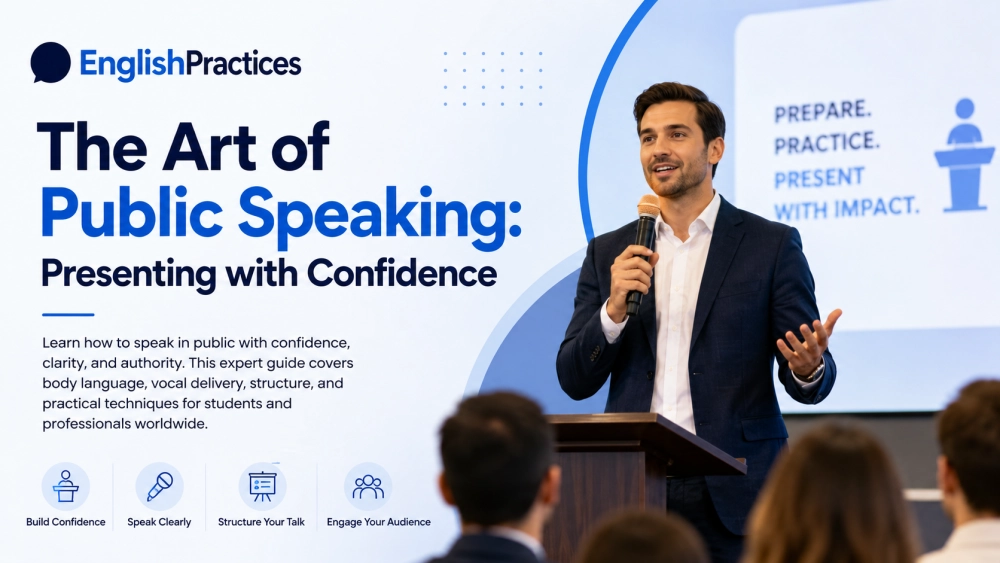
Quick Answer: Public speaking with confidence starts with preparation, controlled breathing, deliberate eye contact, and a clear message structure. Whether you are a student preparing for an IELTS speaking test or a professional presenting to a boardroom in Singapore, the core skills are the same — and every single one of them is learnable.
Introduction: Why Public Speaking Is the Skill That Changes Everything
Most people do not fear failure. They fear being watched while failing. Public speaking sits right at that intersection of performance and vulnerability, which is exactly why it makes so many people freeze.
According to the National Institute of Mental Health, approximately 73% of the population experiences some degree of speaking anxiety — a condition broadly known as glossophobia. You are not alone, and more importantly, you are not stuck.
Here is what this guide covers: the science behind confidence, how to structure a presentation that keeps any audience engaged, the physical habits that signal authority before you say a word, and the specific language techniques that separate a forgettable speaker from a memorable one. Whether you are preparing for a school presentation in Seoul, an IELTS speaking module in Vietnam, a job interview in London, or a client pitch in New York — this guide gives you a practical, honest roadmap.
The art of public speaking is not a talent reserved for extroverts. It is a skill. And like any skill, it improves with the right method and consistent practice.
What Is the Art of Public Speaking, Really?
Public speaking is the act of communicating a message clearly and effectively to an audience — whether that audience is two people or two thousand. The "art" part comes from how you deliver that message: your tone, your pacing, your body language, and the story you choose to tell.
There is an important distinction that most guides miss: public speaking is not performance. It is a conversation at scale. The moment you stop trying to impress your audience and start trying to serve them — to inform, persuade, or inspire them — your delivery becomes more natural, more confident, and more effective.
This shift in mindset is the first real technique. Everything else builds from it.
The Four Pillars of Confident Public Speaking
1. Preparation — The Foundation That Frees You
Confidence in public speaking does not come from being fearless. It comes from being prepared. When you know your material deeply, your brain is not scrambling to remember facts — it is free to focus on the audience.
The 3-Step Preparation Framework:
| Step | Action | Why It Works |
|---|---|---|
| Outline first | Write your key points before writing sentences | Prevents rambling; gives your speech a skeleton |
| Rehearse aloud | Practice speaking, not just reading silently | Trains your mouth and ear simultaneously |
| Record yourself | Watch or listen to one full rehearsal | Identifies filler words, pacing issues, and posture blind spots |
Preparation also means anticipating questions. Speakers who handle Q&A sessions smoothly appear more authoritative — even if their main presentation had rough edges. Preparing three to five possible questions in advance and rehearsing concise answers is one of the most underrated confidence builders.
2. Vocal Delivery — How You Say It Matters as Much as What You Say
Your voice carries more information than your words. Research from UCLA professor Albert Mehrabian's communication model (widely cited, though often misapplied) suggests that vocal elements — tone, pitch, pace — carry significant weight in how your message lands. The key is not to obsess over percentages, but to recognize that a flat, rapid, monotone delivery will undermine even the most intelligent content.
Key vocal techniques to practice:
- Pace: Slow down more than feels natural. Most nervous speakers rush. A deliberate pace signals calm authority.
- Pause: A two-to-three-second pause after a key point gives the audience time to absorb it — and makes you appear thoughtful rather than uncertain.
- Intonation: Vary your pitch across sentences. Rising intonation signals a question or continuation; falling intonation signals conclusion and confidence.
- Volume: Project from your diaphragm, not your throat. Speak to the person in the back row, always.
- Enunciation: Crisp consonants and open vowels improve clarity across accents. This is particularly important for non-native English speakers presenting to mixed international audiences.
3. Body Language — Your Body Speaks Before Your Mouth Does
Before you say a single word, your audience reads your posture, your eye contact, and where your hands are. These physical signals communicate confidence — or the absence of it — instantly.
The non-negotiables of confident body language:
- Posture: Stand with feet shoulder-width apart, weight evenly distributed. Avoid swaying, shifting, or leaning on furniture. This "power stance" reduces cortisol and increases testosterone, according to research by social psychologist Amy Cuddy at Harvard Business School — a finding that, while debated in replication studies, aligns with what coaches observe in practice.
- Eye contact: Hold eye contact with one person for a complete thought (roughly three to five seconds), then move to another. This creates connection across the room. Scanning the ceiling or reading from slides signals disengagement.
- Gestures: Use open-palm gestures to reinforce points. Avoid crossing your arms, touching your face, or putting hands in your pockets. Gestures that match your words amplify their meaning — those that contradict your words create confusion.
- Facial expression: Your face should match your message. A slight smile during an introduction signals approachability. Seriousness during a critical argument signals gravity. Blank expressions during any part of a presentation signal disinterest.
Global context matters here. In Japan and South Korea, sustained eye contact can feel aggressive; in the United States and the United Kingdom, avoiding it signals evasion. Adapt your calibration to the cultural context of your audience.
4. Structure — The Architecture of a Persuasive Speech
No matter how confident your delivery, a poorly structured speech loses audiences. The human brain craves narrative logic. It looks for a beginning, a middle, and an end.
The Classic Three-Part Structure:
| Section | Purpose | Approximate Length |
|---|---|---|
| Opening | Hook the audience; state your central message | 10–15% of total time |
| Body | Develop 2–3 main points with evidence and examples | 70–80% of total time |
| Closing | Summarize, call to action, memorable final line | 10–15% of total time |
The opening is where most speakers waste their opportunity. Starting with "Good morning, my name is..." is a missed chance. Instead, open with a surprising fact, a specific question directed at the audience, or a short story that frames your theme. The first thirty seconds determine whether your audience decides to listen.
For the body, use the Point → Evidence → Explanation method for each idea:
- State your point clearly.
- Offer a specific piece of evidence (a statistic, an example, a quote from a credible source).
- Explain why that evidence supports your point and connects to your central message.
The closing should circle back to your opening — a technique called "bookending." It gives your speech a satisfying sense of completion and makes your core message stickier in the audience's memory.
Common Public Speaking Mistakes — and How to Fix Them
Even experienced speakers fall into predictable traps. Awareness is the first fix.
| Mistake | Why It Happens | The Fix |
|---|---|---|
| Over-relying on slides | Fear of forgetting content | Know your material; use slides as visual support only |
| Filler words ("um", "uh", "like") | Nervous habit, fear of silence | Replace with a deliberate pause; practice silence |
| Speaking too fast | Adrenaline response under pressure | Set a slower pace in rehearsal until it becomes default |
| Lack of eye contact | Reading from notes or slides | Reduce note cards; practice with friends as audience |
| Weak opening | Defaulting to self-introduction | Prepare your first sentence word-for-word in advance |
| No clear takeaway | Trying to say too much | Edit ruthlessly; one central message per presentation |
One technique that cuts several of these mistakes simultaneously: video yourself once a week. Most people never see themselves speak. Watching a five-minute recording of your own presentation is uncomfortable — but it surfaces habits you cannot feel while speaking. After three weeks of this practice, most learners notice measurable improvement in pace, posture, and filler-word frequency.
Public Speaking in Different Global Contexts
The core skills of public speaking are universal. The stylistic expectations are not.
United Kingdom and North America: Audiences tend to value directness, structured argument, and confident eye contact. Self-deprecating humor works well as an opener in British professional settings. American business presentations often reward energy, optimism, and a clear value proposition delivered quickly.
East Asia (Japan, South Korea, China): Formality, respect for hierarchy, and modesty often carry more weight than personal charisma. Opening with acknowledgment of the audience's expertise signals respect rather than weakness. Avoid confrontational rhetorical questions.
Southeast Asia (Vietnam, Thailand, Singapore): Singapore's multicultural business environment rewards clarity and professionalism. In Thailand, a warm, relationship-focused opening tends to land better than diving straight into content. Vietnamese academic and professional audiences respond well to well-organized, evidence-based presentations.
Mexico and Latin America: Personal connection and warmth matter enormously. A presentation that feels cold or overly transactional tends to disengage audiences. Starting with a shared experience or a culturally relevant reference builds trust before content.
This global range is exactly why learners at EnglishPractices.com (EP.) come from over forty countries. The English skill set provides the technical foundation; cultural awareness sharpens the delivery
Practical Techniques You Can Use This Week
You do not need a stage or a formal audience to practice public speaking. You need a commitment to daily, deliberate habits.
Five techniques to start immediately:
- The Mirror Drill: Spend five minutes a day speaking to yourself in the mirror on any topic. Watch your facial expressions. This trains facial awareness without external pressure.
- The One-Minute Talk: Pick a random topic (a favorite meal, a recent news story, a hobby) and speak for exactly sixty seconds without stopping. Record it. Review the filler words. Repeat.
- Read Aloud Daily: Reading a paragraph from a newspaper or book aloud for ten minutes each morning improves articulation, pacing, and breath control simultaneously. This is a habit shared by many professional broadcasters and actors.
- Join a Speaking Group: Toastmasters International operates in over 140 countries and runs meetings in English at all proficiency levels. The structured, low-stakes environment accelerates improvement significantly.
- Present to a Friend: Deliver your next presentation to one person who will give you honest feedback. Real-time audience reaction — even from a single person — trains your instincts in ways solo practice cannot.
How EnglishPractices.com Supports Your Speaking Journey
At EP., public speaking confidence is not treated as a bonus skill. It is a core outcome across multiple learning tracks — because real English fluency only becomes visible when you open your mouth.
With 19+ years of experience supporting learners in the UK, North America, and across Asia including Vietnam, Thailand, South Korea, Japan, Singapore, and China — the team at EnglishPractices.com has developed structured programs that address both the linguistic and psychological dimensions of confident speaking.
From IELTS speaking band improvement to business presentation coaching for corporate professionals, EP. takes a genuinely practical approach: fewer drills, more real-world simulations. Sessions are built around your actual communication goals, not generic scripts.
Learners preparing for professional presentations, academic defenses, or international job interviews benefit most from EP.'s integrated method — one that combines vocabulary development, pronunciation training, and structured feedback on delivery. The result is not just better English. It is a version of you that speaks with clarity, authority, and presence.
Conclusion: The Speaker You Want to Be Is Already in You
Confident public speaking is not a personality trait you either have or do not. It is a craft you build, one prepared presentation at a time. The speakers you admire — the TED Talk presenters, the debate champions, the business leaders who command a room — they all started exactly where you are.
They practiced. They stumbled. They practiced again.
What separates them is not talent. It is the decision to keep going after the awkward silences, the forgotten words, and the presentations that did not land the way they intended. Every one of those experiences is data. Every one of those experiences is progress.
Start with one technique from this guide this week. Record yourself. Join a speaking group. Prepare an opening sentence that surprises. Small, specific actions compound into transformation.
Ready to build speaking confidence with structured, expert support? Explore EP.'s speaking programs at EnglishPractices.com and find the right track for your goals — whether you are chasing an IELTS band score, preparing for a job interview in English, or simply ready to stop dreading every time someone asks you to speak up.