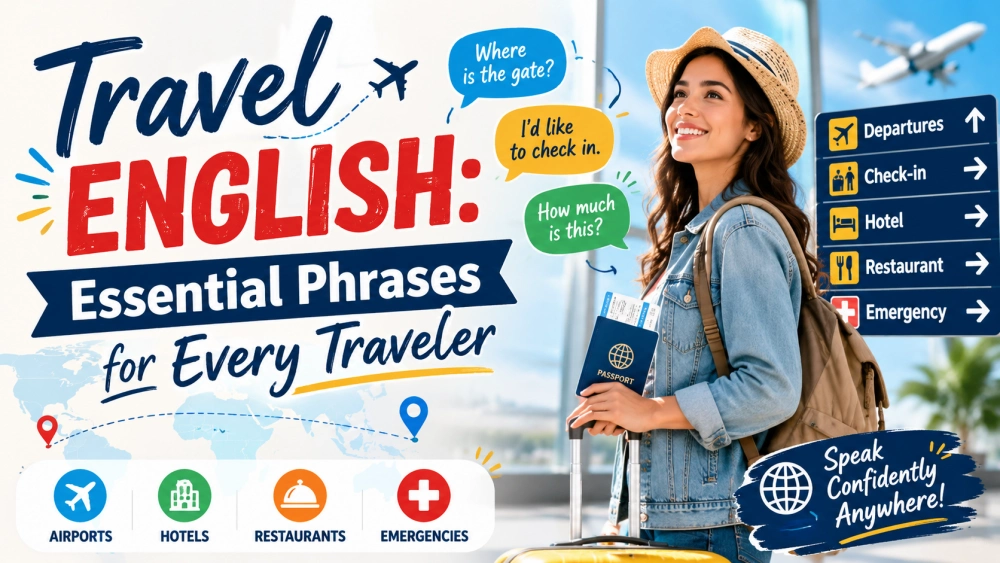
Every year, millions of travelers step off a plane in a foreign city carrying one silent anxiety: what do I actually say? Whether you're a university student backpacking through Southeast Asia, a professional flying through Heathrow for a conference, or a first-time traveler visiting family in another country, the gap between classroom English and real-world travel English can feel surprisingly wide.
Travel English is the practical, situational language you need to move through airports, hotels, restaurants, and unfamiliar streets with confidence. It is not about achieving a perfect accent or passing a grammar exam. It's about getting things done — clearly, politely, and without unnecessary friction.
This guide organizes essential travel English phrases by real-life situation, so you learn what you actually need before you need it. By the end, you'll have a ready-to-use language toolkit that works whether you're clearing customs in Bangkok, catching a train in London, or ordering dinner in Tokyo.
The most essential travel English phrases cover six situations — airport check-in, immigration, hotel, restaurant, transport, and emergencies. Mastering 20–30 phrases per context prepares you for the vast majority of travel interactions worldwide.
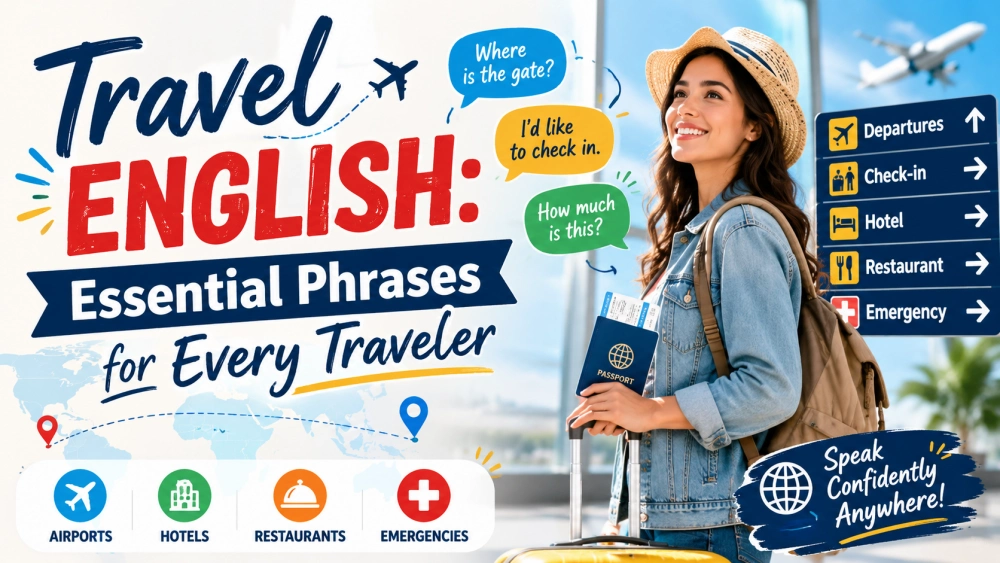
Why Travel English Is Different from Classroom English
Most English curricula teach you how to construct grammatically correct sentences. Travel situations demand something different: fast, clear, functional communication — often with people who also speak English as a second language.
Here's what makes it distinct. English is the official language of international civil aviation, as designated by the International Civil Aviation Organization (ICAO) under Annex 1 to the Convention on International Civil Aviation. Every pilot and air traffic controller worldwide communicates in English. That means airport English is highly standardized, formulaic, and predictable — which is actually good news for learners, because predictable means learnable.
Restaurant English, on the other hand, is fast, informal, and regional. Hotel English involves polite requests and complaint resolution. Emergency English needs to be direct and calm under pressure. Each environment has its own mini-vocabulary and its own social expectations.
The core insight: you don't need to be fluent to travel effectively. You need to be situationally prepared.
A student who has practiced 15 airport phrases will outperform a high-scorer who has never used English outside a classroom. Fluency is built through use, not study alone — which is exactly why beginner English communication skills matter so much before your first trip.
At the Airport: Phrases That Get You Through Without Friction
The airport is where nerves tend to surface. Long queues, garbled PA announcements, immigration officers firing rapid questions — it's a high-stimulus environment. The good news is that airport conversations follow a tight, predictable script on both sides of the counter.
Check-In and Boarding Phrases
These are the phrases you'll use most at the check-in desk:
- "I'd like to check in for my flight to [destination], please."
- "I have one bag to check and one carry-on."
- "Is my seat assigned, or can I choose one?"
- "Could I have a window / aisle seat, please?"
- "What is the luggage allowance for this flight?"
- "Where is Gate [number]?"
When an agent says something you don't catch, don't freeze. Simply say: "I'm sorry, could you repeat that more slowly, please?" Airport staff worldwide are trained to assist travelers from every language background. Asking for clarification is completely normal — and far better than nodding and walking away confused.
Immigration and Customs: The Questions You'll Always Hear
Immigration officers tend to ask the same core questions regardless of country. Preparing these five in advance removes almost all the stress.
| Officer's Question | Strong, Ready-to-Use Answer |
|---|---|
| "What is the purpose of your visit?" | "I'm here for tourism / a business conference / to visit family." |
| "How long will you be staying?" | "I'll be staying for [X] days / two weeks." |
| "Do you have anything to declare?" | "No, I have nothing to declare." / "Yes, I have some gifts." |
| "Where will you be staying?" | "I'll be staying at [hotel name] in [city]." |
| "Do you have a return ticket?" | "Yes, I'm flying back on [date]." |
Keep answers short, direct, and honest. Immigration is not a conversation — it's a screening process. One clean sentence per question is always better than a long explanation.
Good pronunciation clarity helps here more than anywhere else. If officers regularly ask you to repeat yourself, working on clear English pronunciation for formal settings before travel pays dividends immediately.
Hotel Check-In: Getting Your Room and Solving Problems Politely
Once you've cleared the airport, your accommodation is the next major English interaction. Hotel conversations are more relaxed, but they follow a familiar pattern worth practicing in advance.
Standard Check-In Phrases
- "I have a reservation under the name [your name]."
- "I booked a [single / double / twin] room for [X] nights."
- "Could I have a room on a higher floor / away from the street?"
- "What time is checkout?"
- "Is breakfast included?"
- "Could I store my luggage until check-in time?"
Reporting a Problem Effectively
Things don't always go smoothly. A practical phrase pattern for any hotel issue is: state the problem first, then ask for a solution. This structure is clear and polite in any English-speaking culture.
- "The air conditioning in my room isn't working — could someone come and check it?"
- "There's no hot water in the shower. Could you move me to another room or send someone to fix it?"
- "I think there's been a mistake with my booking. I reserved a double room, but I've been given a twin."
- "Could I request extra towels and pillows, please?"
Notice the difference between "Wi-Fi broken" and "The Wi-Fi in my room isn't connecting — could someone help me with that?" The second phrase is more likely to result in fast, helpful action because it gives the staff member exactly what they need to solve it.
Practicing listening exercises using real hotel-style dialogues helps you understand fast, native-speed responses. Improving your English listening for real-life situations specifically prepares you for this kind of back-and-forth exchange.
Restaurant English: Ordering Food with Confidence
Food is one of travel's great pleasures, and restaurant English is more conversational than most other travel settings. The pace is slower, the stakes are lower, and there's usually a menu to point at when words fail. Still, knowing a few key phrases turns a potentially awkward experience into an enjoyable one.
Making a Reservation and Arriving
- "I'd like to make a reservation for [number] people at [time], please."
- "Do you have a table available this evening, around 7 PM?"
- "Do you have any vegetarian / vegan / gluten-free options?"
Ordering and Requesting Changes
- "Could I see the menu, please?"
- "What do you recommend?"
- "I'll have the [dish name], please."
- "Could I have that without [ingredient]? I'm allergic to [ingredient]."
- "Is this dish spicy?"
Handling Problems and Paying
| Situation | What to Say |
|---|---|
| You don't understand a dish | "Could you explain what this is?" |
| You have an allergy | "I'm allergic to [ingredient]. Does this contain it?" |
| The order is wrong | "Excuse me, I ordered the [dish] — I think there's been a mix-up." |
| You're ready to pay | "Could we have the bill / check, please?" |
A small but useful regional note: in the UK and most Commonwealth countries, people say "bill." In North America, "check" is standard. In Thailand, Vietnam, Singapore, and Japan's tourist areas, both are widely understood. Neither is wrong — context makes it clear.
Getting Around: Transport English for Trains, Buses, and Taxis
Taxis and Rideshares
- "Could you take me to [destination], please?"
- "How much will that cost, approximately?"
- "Could you use the meter, please?"
- "Please drop me off here — just on the left."
- "Could I get a receipt?"
Trains, Buses, and Metro Systems
Public transport vocabulary matters most in cities like London, Tokyo, Seoul, or Mexico City, where metro systems are complex and English signage is inconsistent.
- "Which platform does the train to [destination] leave from?"
- "Is this the right bus for [destination]?"
- "Could I have a single / return ticket to [city], please?"
- "How many stops until [station name]?"
- "Does this train stop at [station]?"
British vs. American Transport English: Key Differences
This distinction matters especially if you're preparing for standardized exams. IELTS uses British English conventions, while TOEIC draws from both American and international business contexts.
| Concept | British English | American English |
|---|---|---|
| One-way ticket | Single | One-way |
| Round-trip ticket | Return | Round-trip |
| Underground / Metro | The Tube / Underground | Subway |
| Baggage storage | Left luggage | Baggage check |
| Elevator | Lift | Elevator |
If you're actively preparing for either exam while planning travel, combining your exam prep with real-world vocabulary is a highly efficient strategy.
Shopping and Currency Exchange: The Language of Transactions
Shopping abroad is where informal English and numbers intersect. Even confident English speakers sometimes hesitate when prices, change, or conversion rates are involved.
At a Shop
- "How much does this cost?"
- "Do you have this in a different size / color?"
- "I'm just looking, thank you."
- "Could I try this on?"
- "Do you accept credit cards / contactless payment?"
- "Could you give me a discount?" — useful in markets across Southeast Asia, the Middle East, and parts of Latin America
At a Currency Exchange Counter
- "What is today's exchange rate for [currency]?"
- "I'd like to exchange [amount] of [currency], please."
- "Is there a commission fee?"
- "Could I have smaller bills / notes, please?"
One note on vocabulary: in American English, paper money is called "bills." In British English, they're called "notes." At international currency exchanges, either term is understood — but knowing both prevents confusion when you hear the other.
Emergency Phrases: Staying Calm When It Matters Most
Emergency situations are where preparation earns its highest return. When you're stressed, scared, or disoriented, simple and direct English serves you far better than complex sentences.
Medical Emergencies
- "I need help urgently. Please call an ambulance."
- "I feel very unwell / I'm having trouble breathing."
- "I'm allergic to [substance]."
- "Where is the nearest hospital / pharmacy?"
Lost or Stolen Items
- "My bag / passport / wallet has been stolen."
- "Where is the nearest police station?"
- "I need to contact my country's embassy."
- "I'd like to file a police report."
General Safety
- "Please call the police."
- "Is there a doctor here?"
- "I need help immediately."
In any emergency, speak at a moderate pace and keep your sentences short. If someone doesn't understand, calmly repeat the single most important word — "ambulance," "police," "hospital" — rather than speeding up or rephrasing into something more complex. Short, repeated, clear words land better under pressure than long explanations.
Common Mistakes Travelers Make in English — and How to Avoid Them
Even intermediate-level learners fall into a few consistent traps abroad. Recognizing these in advance saves real-world frustration.
Mistake 1: Over-apologizing before asking a question. Saying "I'm so sorry to bother you, but I was just wondering if maybe you could possibly help me..." makes you sound uncertain and makes staff work harder to understand your actual request. Instead: "Excuse me, could you help me find Gate 12?" — direct and polite.
Mistake 2: Using yes/no ambiguously. In some cultures, nodding or saying "yes" is a way to show you're listening, not that you agree or understand. In English-speaking contexts, "yes" typically signals agreement or confirmation. If you're still processing, say: "Give me a moment, please."
Mistake 3: Failing to clarify when confused. Many travelers stay silent when they don't understand something, then make a wrong decision as a result. There is no social penalty for asking someone to repeat themselves or speak more slowly. In international settings, it's expected.
EnglishPractices.com: Where Travel English Becomes Real-World Fluency
At EP., we've spent nearly two decades working with learners across Vietnam, Thailand, South Korea, Japan, Singapore, China, Mexico, and global markets who share one goal: practical English that works outside a textbook.
The learners who progress fastest aren't always those who score highest on practice tests. They're the ones who apply English in real-world settings — including travel. Our courses at EnglishPractices.com are built around situated, contextual learning: you practice English the way you'll actually use it, in the situations where you'll actually need it.
For travel English specifically, that means:
- Roleplay conversations simulating check-in desks, restaurants, and transport queries
- Listening modules using real airport announcements and hotel dialogue recordings
- Vocabulary sets organized by destination type — business travel, academic exchange, or leisure tourism
- Exam-integrated pathways for learners who want to combine IELTS or TOEIC vocabulary preparation with genuine travel readiness
Whether this is your first solo trip or your twentieth business trip abroad, EP. provides structured, practical pathways to get you speaking with confidence — not just studying in silence.
Quick-Reference: Essential Travel English Phrases at a Glance
| Situation | Key Phrase to Know |
|---|---|
| Airport check-in | "I'd like to check in for my flight to [destination], please." |
| Immigration | "I'm here for tourism / business / to visit family." |
| Hotel check-in | "I have a reservation under the name [your name]." |
| Hotel complaint | "There's a problem with my room — could someone help?" |
| Restaurant | "I'll have the [dish], please. Could I have it without [ingredient]?" |
| Transport | "Which platform for the train to [destination]?" |
| Shopping | "How much does this cost? Do you accept cards?" |
| Emergency | "I need help immediately. Please call an ambulance." |
Conclusion: Your Next Trip Starts with These Phrases
Travel English is not a special dialect reserved for advanced speakers. It is your existing English skills applied to specific, predictable situations. The phrases in this guide cover the vast majority of what you'll face in airports, hotels, restaurants, and public transport across the globe — from London to Seoul to Mexico City to Ho Chi Minh City.
Start with the situations that feel most stressful. For most travelers, that's the airport and immigration. Practice those phrases until the words feel automatic. Then build outward to restaurant English, shopping, transport, and emergency situations.
If you're serious about improving your travel English — or preparing for an international exam like IELTS or TOEIC at the same time — the team at EnglishPractices.com is ready to help you build a study plan that fits your actual goals and timeline.
Ready to speak confidently on your next trip? Start your free English assessment at EnglishPractices.com today — and travel with the words you need.